Projects
Every project of the Immersive Reality Lab, running and completed.
€4.609 million in third-party funding across 22 projects and 10 funding lines, raised by our director since 2015 — at TU Berlin before he came to HSHL in 2021, and here since.
Current projects (6)
- Immersive Theatre Training (ITT) for Safety & Skills in Theatre
2026–2028
The project 'Immersive Theatre Training (ITT)' represents a groundbreaking innovation in the field of education and training for theatre and event technicians and managers. Through the targeted use of… - Adaptive XR-Trainings for Human-Centered and Functional Safety Cases - XRT-HuFuSa
2026–2028
The project develops an extended reality (XR) training platform that combines digital twins (DTs), real-world data, and AI-driven personalization to enable practical qualification measures in safety-c… - International Network for Future Universal Skills Education
2026–2028
The INFUSE – International Network for Future Universal Skills Education project at Hamm-Lippstadt University of Applied Sciences (HSHL) addresses a fundamental challenge: more than 60% of HSHL studen… - Digitalise South Westphalia
2023–2027
The Virtual Institute for Virtual and Augmented Reality (VI VR/AR) is a collaborative network of experts from South Westphalia University of Applied Sciences and Hamm-Lippstadt University of Applied S… - Silent Bed Health Monitoring System
2025–2027
The SilentBedMonitor project aims to develop an innovative health monitoring system that integrates discreet, high-precision weight sensors into bed frames to detect even subtle changes in a patient’s… - The Knowledge Network
2025–2027
The XRwise Knowledge Network is building a learning platform that makes sharing knowledge more sustainable, eases access to knowledge, and helps make teaching at universities more intuitive. To do thi…





Completed projects (12)
- Multimodal user interface: requirements definition, concept design, implementation; app validation
2024–2026
The ARiadne project aims to develop an innovative augmented reality (AR) navigation application for pedestrians that utilizes the possibilities of immersive media. In contrast to conventional navigati… - DIgital, DYnaMic and respOnsible twinS for XR
2023–2025
The vision of DIDYMOS-XR is to enable realistic and dynamic XR applications using AI. Therefore, the project focuses on advancing technologies for the creation of large-scale digital twins that are sy… - Digital On Track
2023–2025
The DigiOnTrack project is developing a cost-effective, wireless monitoring system for tracks and vehicles, based on simple retrofit solutions. In the long term, the project aims to reduce maintenance… - Multimodal Interactive Assistant (MIA) - Patient Reported Outcome Measures (PROMs)
2022–2025
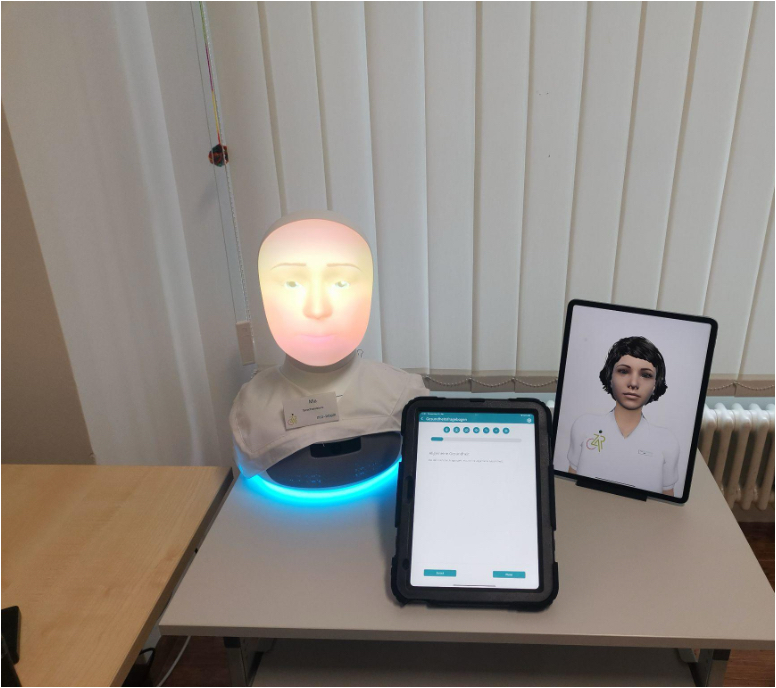
Collecting patient feedback is essential for evaluating medical treatments. One valuable method is using Patient Reported Outcome Measures (PROMs) questionnaires that capture patients’ experiences bef… - XR Emergency Training for Military Fast Jets
2024–2025
The XR Emergency Training project focuses on the evaluation of immersive training methods for emergency procedures in military aviation. By combining extended reality (XR) simulations with psychophysi… - Adaptive Speech Training for Older Adults with Aphasia
2018–2021
Advances in digital technology development for aphasia rehabilitation offer hope for those affected, even though an aging society increases the likelihood of strokes. The VoiceAdapt project aims to em… - Augmented Reality for the Tourism Industry in a Changing Era
2020–2021
After COVID-19, social distancing rules will have a decisive impact on the tourism industry; fewer trips and tickets will be sold, access to attractions and museums will be restricted, and overall unc… - Occupational Health Management in Nursing
2020–2021
A quarter of people in need of care in Germany currently live in full-time residential long-term care facilities (Federal Statistical Office 2018). The continuously increasing number of people requiri… - Digital health research to enhance mobility and participation in rural ageing populations
2018–2021
Especially in rural areas, the integration of resources from health services and from personal care networks is crucial for maintaining mobility and autonomy in old age and thus for ensuring effective… - Tablet-Based Outpatient Care for People with Dementia
2018–2021
In Germany, the care of people with dementia is predominantly provided by general practitioners, sometimes with the involvement of specialists. Evidence-based diagnostic and treatment recommendations,… - Technology for More Quality of Life Despite Dementia Care Needs
2015–2018
The aim of the project is to develop a transferable model for technology-supported care and activation, and to scientifically evaluate the use of PflegeTab. The main motivation of the project is to en… - Neurotechnologies for improving intuitive and efficient human–machine interaction
2008–2014
Neuroscientific results can be exploited for developing robust real-world applications with major potential for industry. The Bernstein Focus: Neurotechnology Berlin (BFNT-B) brings together a multidi…