ARiadne
Multimodal user interface: requirements definition, concept design, implementation; app validation
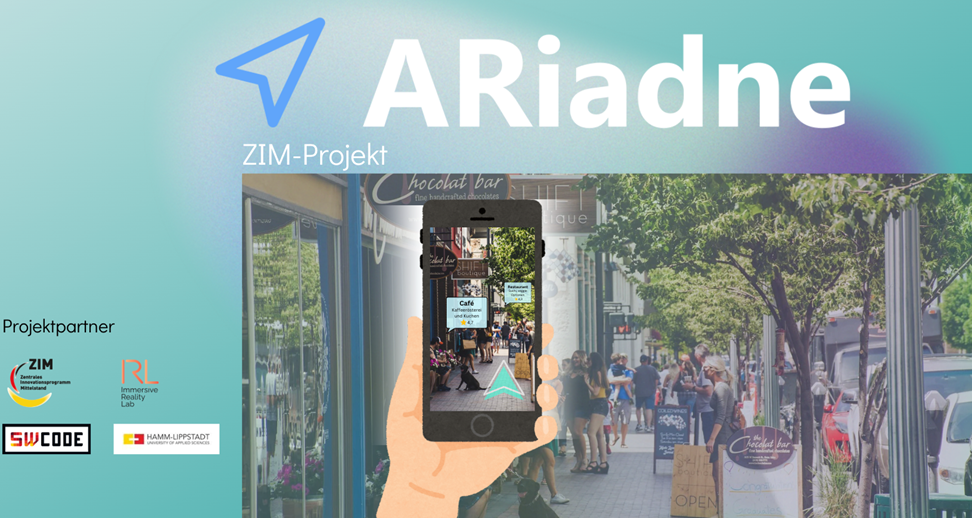
The ARiadne project aims to develop an innovative augmented reality (AR) navigation application for pedestrians that utilizes the possibilities of immersive media. In contrast to conventional navigation apps, ARiadne will offer personalized routes based on individual preferences and integrate additional content such as cultural events. The project is a joint venture between SWCode UG and Hamm-Lippstadt University of Applied Sciences, combining industrial expertise with academic research. SWCode UG will focus on the development of a precise and resource-saving localization process, while the university will work on the multimodal user interface. The project demonstrates the versatility of AR technology in various fields. The expected outcome is a user-friendly, intuitive AR navigation system that improves spatial orientation in complex urban environments and represents a significant advance over current navigation technologies.
- Funders Federal Ministry for Economic Affairs and Energy (BMWE)
- Funding program Central Innovation Program for SMEs (ZIM)
- Funding amount 0.56 Million Euro
- Duration 2024 - 07/2026
Funding


Partners
Team
- Prof. Dr.-Ing. Jan-Niklas Voigt-Antons
Project Lead - Juliane Henning
Research Scientist
ARiadne – High-Precision, Multimodal AR Pedestrian Navigation
The ARiadne project is developing a software development kit (SDK) for high-precision, multimodal, AR-integrated pedestrian navigation. The project is funded through the Central Innovation Program for Small and Medium-Sized Enterprises (ZIM) by the Federal Ministry for Economic Affairs and Energy (BMWi) with a total funding of approximately €565,659. The project duration is from 2024 to 2026. Project partners are Hamm-Lippstadt University of Applied Sciences and the company SWcode. The project aims to develop an AR-based navigation solution that enables personalized routes based on individual preferences. In addition, points of interest (POIs) such as landmarks, shops, restaurants, or museums are incorporated. The integration of additional information, such as events, news, or prices, is also planned.
To achieve these objectives, route guidance is optimized through multimodal projections of directions, landmarks, and supplementary information. High-precision positioning is achieved by fusing and weighting various data sources, including GPS-based navigation and AI-powered image recognition. A self-learning user profile captures user behavior, identifies preferences, and adapts the route accordingly. Three central components are being developed for the ARiadne SDK: the Frontend ARiadne CMS, an easy-to-use content management system for linking virtual content to physical objects; the ARiadne Engine, which uses world-understanding algorithms for placing virtual information and navigation elements; and the ARiadne API, a high-level interface for integration into the Unity 3D engine on iOS and Android devices.
The project’s results so far include a systematic literature review that identified key design and interaction principles and derived evidence-based recommendations for user-centered navigation. Additionally, a survey of 21 participants was conducted to gather requirements and preferences for an AR-based pedestrian navigation app. From this, user personas such as tourists, busy professionals, and young people (e.g., students new to a city) were developed, along with corresponding scenarios such as efficient, fast navigation or a TourGuide mode, taking accessibility into account. Based on these results, functional and non-functional requirements were specified, and design guidelines were developed considering usability, safety, and contextual factors. The next steps involve testing different aspects of navigation, including safety (immersion vs. traffic safety), visual and auditory ergonomics, integration of additional information, and accessibility for people with visual or mobility impairments.
Publications
- Augmented Reality in the Treatment of Stress and Anxiety Disorders: A Literature Synthesis
Vona, F., Kuhlencord, K., Fox, J., Kojic, T., Shiban, Y. & Voigt-Antons, J.-N. (2025, September). Augmented Reality in the Treatment of Stress and Anxiety Disorders: A Literature Synthesis. Paper presented at the first workshop on Designing Safe and Effective Intelligent Virtual Agents (IVAs) for Health Care: Risks, Benefits, and Best Practices (DESIGN IVA HC 2025), Berlin, Germany. - Digital Twins for Extended Reality Tourism: User Experience Evaluation Across User Groups
Warsinke, M., Vona, F., Kojic, T., Möller, S., Voigt-Antons, J.-N. (2025, June). Digital Twins for Extended Reality Tourism: User Experience Evaluation Across User Groups. Paper presented at the International Conference on eXtended Reality (XR Salento 2025), Otranto (Lecce), Italy. - VR Cloud Gaming UX: Exploring the Impact of Network Quality on Emotion, Presence, Game Experience and Cybersickness
Warsinke, M., Kojic, T., Vergari, M. & Voigt-Antons, J.-N. & Möller, S. (2024, October). VR Cloud Gaming UX: Exploring the Impact of Network Quality on Emotion, Presence, Game Experience and Cybersickness. Paper presented at the 23rd IEEE International Symposium on Mixed and Augmented Reality (ISMAR 2024), Greater Seattle Area, USA. https://doi.org/10.1109/ISMAR-Adjunct64951.2024.00166 - The Impact of Social Environment and Interaction Focus on User Experience and Social Acceptability of an Augmented Reality Game
Cocchia, L., Vergari, M., Kojic, T., Vona, F., Möller, S., Garzotto, F. & Voigt-Antons, J.-N. (2024, June). The Impact of Social Environment and Interaction Focus on User Experience and Social Acceptability of an Augmented Reality Game. Paper presented at the 16th International Conference on Quality of Multimedia Experience (QoMEX 2024), Karlshamn, Sweden. https://doi.org/10.1109/QoMEX61742.2024.10598279 - Protect and Extend - Using GANs for Synthetic Data Generation of Time-Series Medical Records
Ashrafi, N., Schmitt, V., Spang, R. P., Möller, S. & Voigt-Antons, J.-N. (2023, June). Protect and Extend - Using GANs for Synthetic Data Generation of Time-Series Medical Records. Paper presented at the 15th International Conference on Quality of Multimedia Experience (QoMEX 2023), Ghent, Belgium. Diversity and Societal Impact Award. https://doi.org/10.1109/QoMEX58391.2023.10178496 - An Investigation of the Influence of Ambient Noise on User Experience in Virtual Reality
Kojic, T., Vergari, M., Vona, F., Voigt-Antons, J.-N. & Möller, S. (2023, June). An Investigation of the Influence of Ambient Noise on User Experience in Virtual Reality. Paper presented at the 15th International Conference on Quality of Multimedia Experience (QoMEX 2023), Ghent, Belgium. https://doi.org/10.1109/QoMEX58391.2023.10178532 - Influence of Interactivity and Social Environments on User Experience and Social Acceptability in Virtual Reality
Vergari, M., Kojić, T., Vona, F., Garzotto, F., Möller, S. & Voigt-Antons, J.-N. (2021, March). Influence of Interactivity and Social Environments on User Experience and Social Acceptability in Virtual Reality. Paper presented at the IEEE Conference on Virtual Reality and 3D User Interfaces (IEEE VR 2021), Lisbon, Portugal. IEEE VR 2021 - Conference Paper Honorable Mention. https://doi.org/10.1109/VR50410.2021.00096 - Emotional Responses to Thermally Augmented Audiovisual Stimuli
Greiner, S., Antons, J.-N. & Wechsung, I. (2015, May). Emotional Responses to Thermally Augmented Audiovisual Stimuli. Paper presented at the 7th Int. Workshop on Quality of Multimedia Experience (QoMEX 2015), Costa Navarino, Messinia, Greece. https://doi.org/10.1109/QoMEX.2015.7148140 - Impact of spatial auditory navigation on user experience during augmented outdoor navigation tasks
Voigt-Antons, J.-N., Sun, Z., Vergari, M., Ashrafi, N., Vona, F., & Kojić, T. (2023, März). Impact of spatial auditory navigation on user experience during augmented outdoor navigation tasks. Paper presented at the annual congress of the Deutsche Gesellschaft für Akustik (DAGA 2023), Hamburg, Germany. https://pub.dega-akustik.de/DAGA_2023/data/articles/000424.pdf - Dementia and the role of evidence-based guidelines in primary care – Results of a cluster randomised controlled trial
Lech, S., O´Sullivan, J. L., Spang, R. P., Voigt-Antons, J.-N., Gellert, P. & Nordheim, J. (2022, November). Dementia and the role of evidence-based guidelines in primary care – Results of a cluster randomised controlled trial. Paper presented at the GSA Annual Scientific Meeting. https://doi.org/10.1093/geroni/igac059.1829