BGF Pflege
Occupational Health Management in Nursing
A quarter of people in need of care in Germany currently live in full-time residential long-term care facilities (Federal Statistical Office 2018). The continuously increasing number of people requiring care contrasts with a nationwide shortage of qualified professionals and specialists in elderly care. Studies on working conditions show that employees in the care sector face a large number of above-average demands (e.g., time pressure, work intensification, heavy physical work, or atypical working hours). Workplace health promotion for staff, as well as prevention and health promotion for residents in residential long-term care facilities, can help to reduce health risks and burdens related to workplace and institutional conditions and to promote or restore the health of staff and residents. The project “BGF Pflege” is an important building block in the health promotion and organizational development process for residential long-term care facilities. Objective of the BGF Pflege study: The aim of the project is to develop an assessment tool for residents and a self-evaluation tool for staff, which, based on digitally collected information, identifies resources and burdens from the perspective of the target groups. The instruments developed in this context enable a comprehensive documentation of the prevention and health promotion needs of residents and staff. They thus form the basis for targeted counseling and planning of measures in long-term care facilities, taking into account already successfully implemented occupational health management offers. In addition, they enable health insurance providers to fulfill their tasks of advising and supporting care facilities in workplace health promotion and prevention, following the premise of the setting-based approach.
- Funders AOK Nordost
- Duration 01/01/2020 - 12/31/2021
Funding

Partners

- Stationäre Langzeitpflegeeinrichtungen in Berlin, Brandenburg und Mecklenburg-Vorpommern

Team
- Prof. Dr.-Ing. Jan-Niklas Voigt-Antons
Project Lead
Inside the application
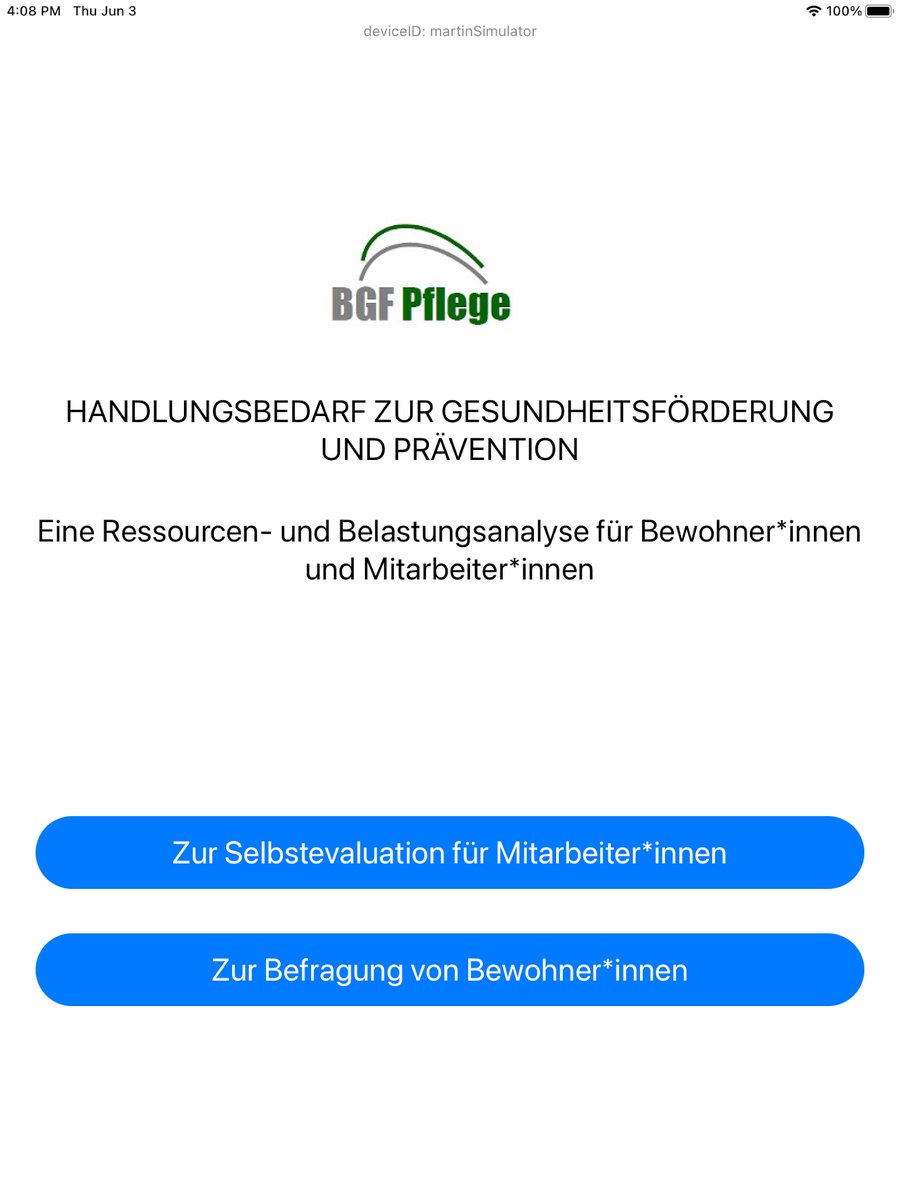
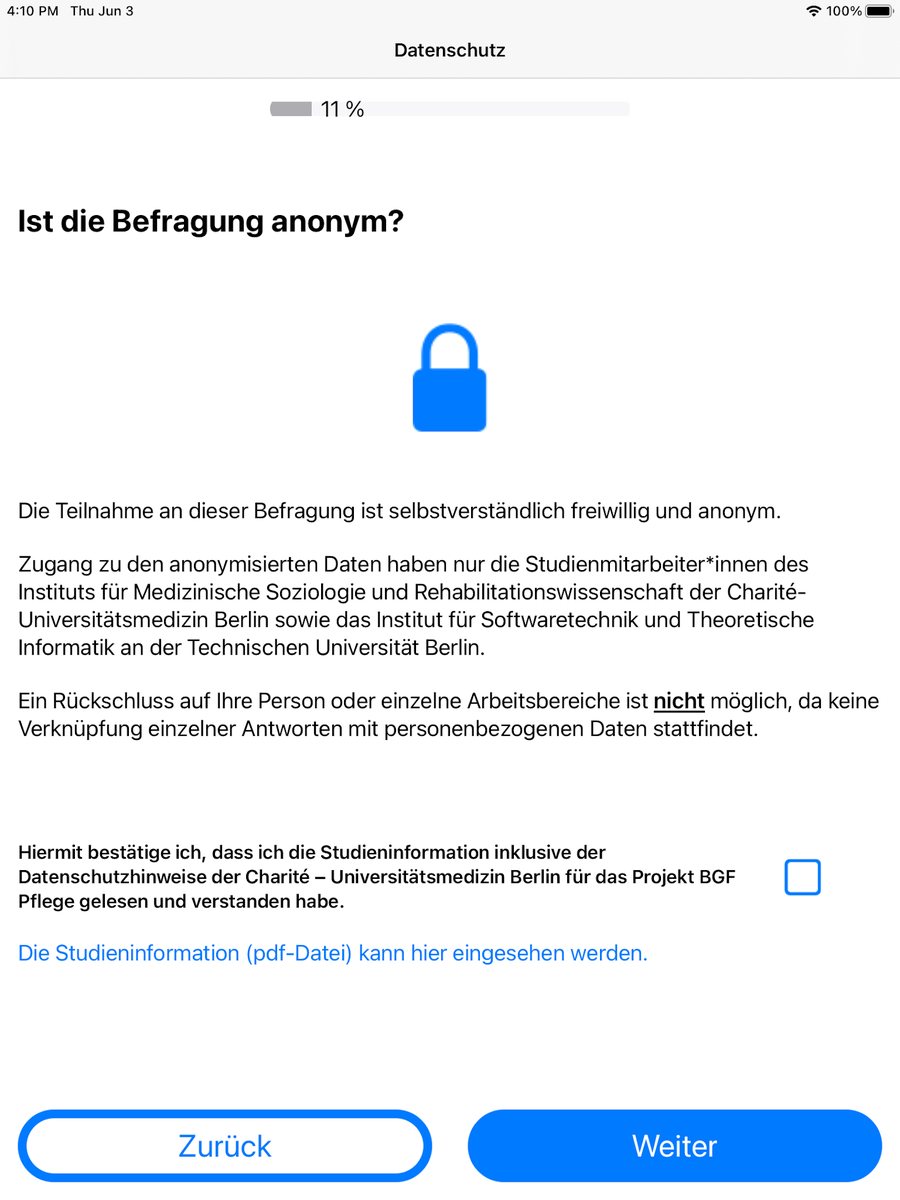
The same application serves two very different groups. Staff answer for themselves and about residents; residents and their relatives answer for themselves, on screens designed for age-related impairments. Answers are given on sliders, scales or as multiple choice, and follow-up questions appear only where the previous answer calls for them. A code word links a questionnaire to a person without storing a name.
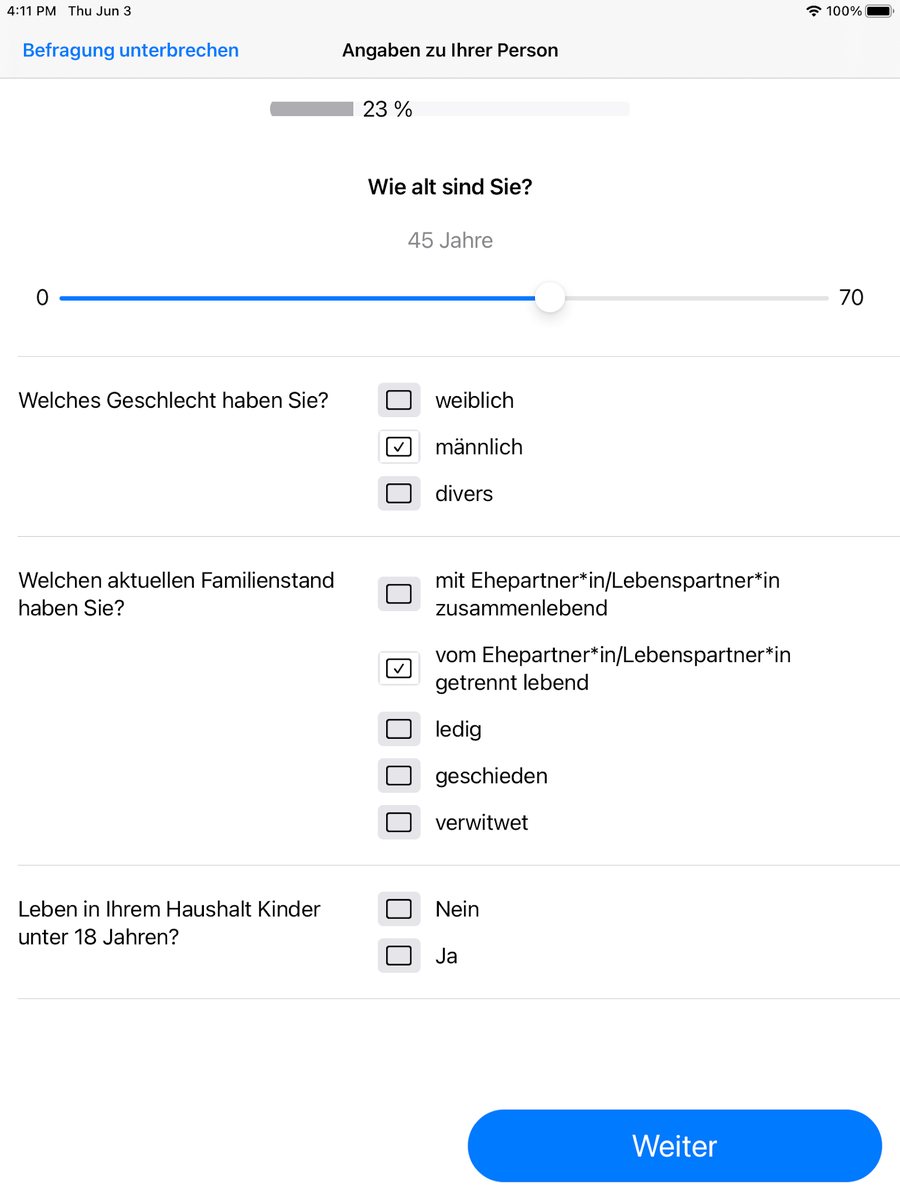
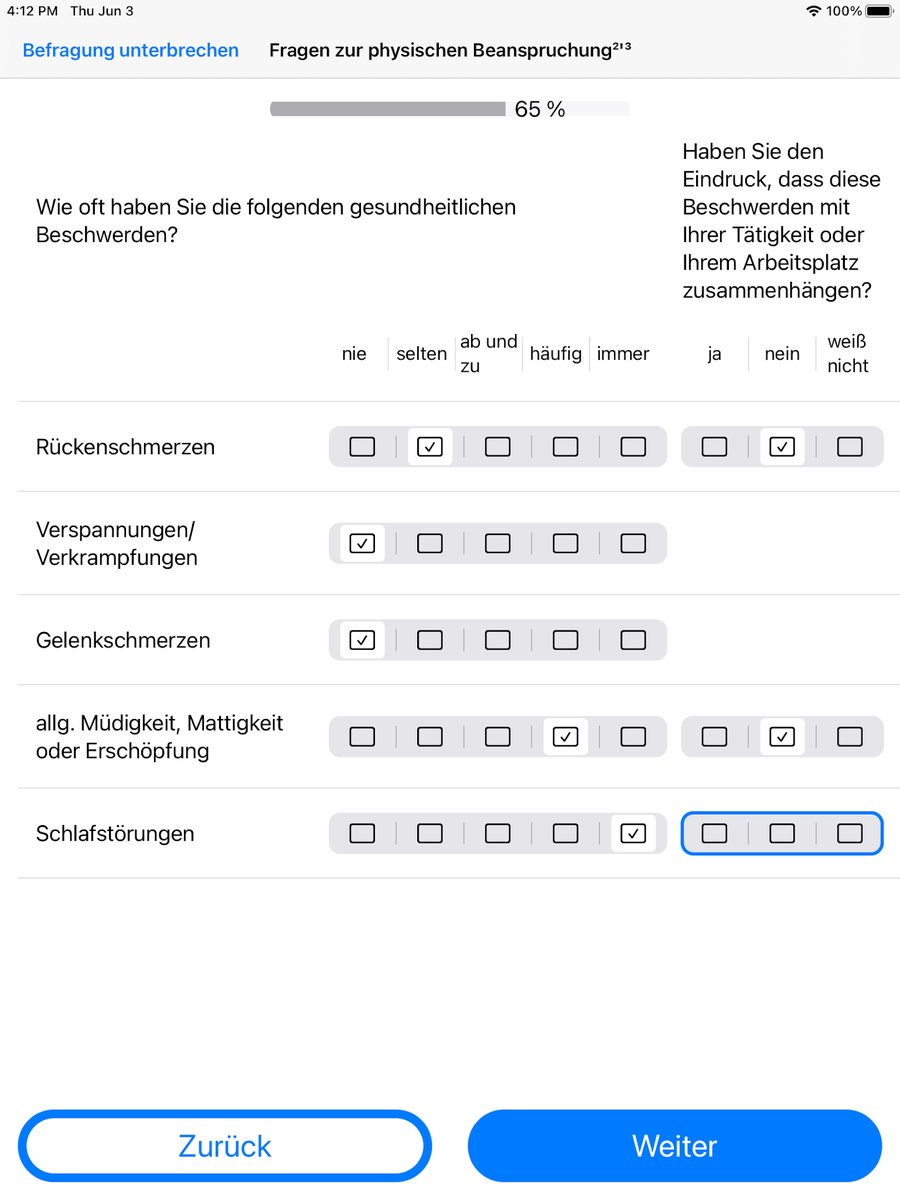
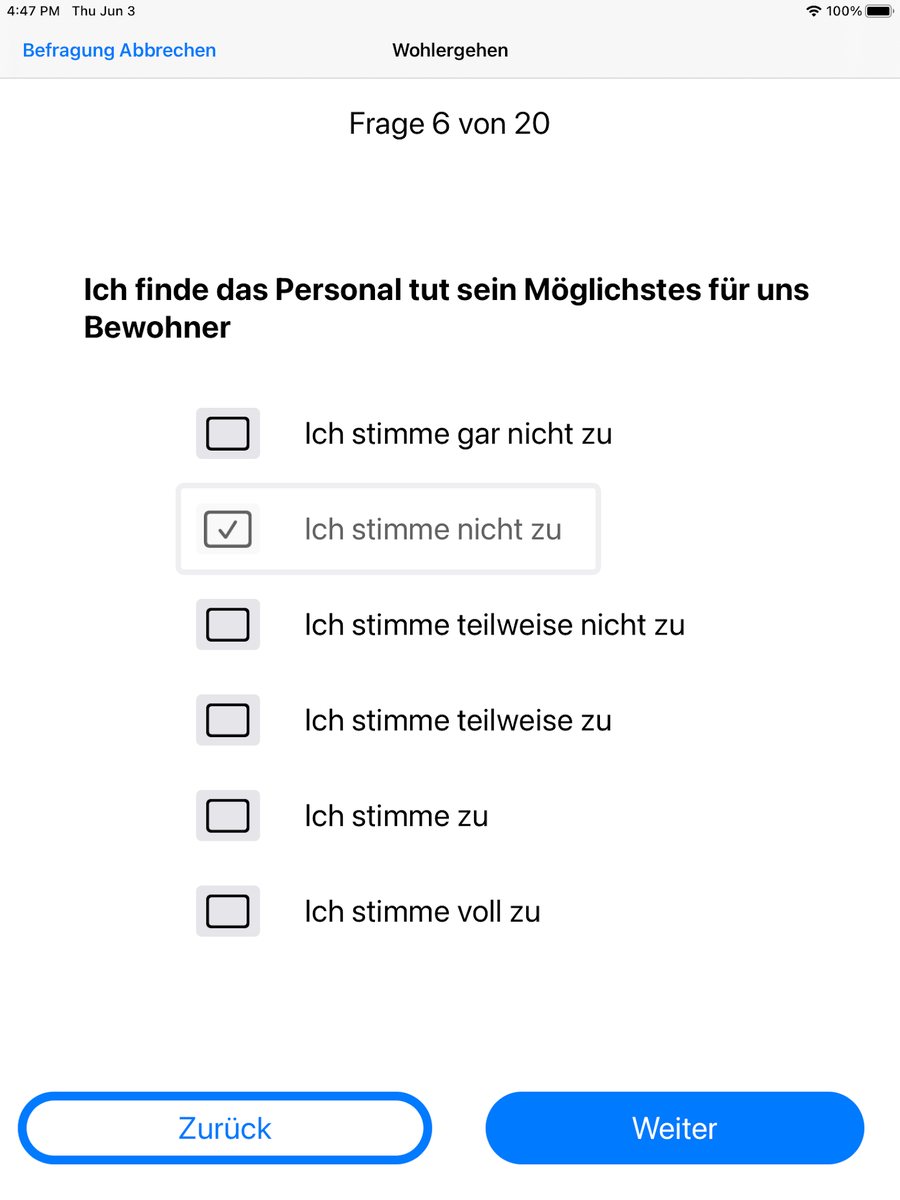
Designed for the people answering
The resident screens follow a list of decisions taken because of what age does to sight, attention and motor control — not because of how they look. White background, black Arial, large type, generous line spacing. One question per screen, so nothing has to be scrolled. An answer can be chosen by tapping its text and not only the small box beside it. Multi-line text is left-aligned, buttons are outlined so their edges are visible, irrelevant visual detail was left out, and touching the screen gives an audible response.
The resident questionnaire is 15 questions on wellbeing and five on nutrition, kept short so that answering is not itself a burden. Both groups get a progress bar, drawn differently for each. A survey can be interrupted at any point and resumed within ten hours — in a care home an interruption is the normal case, not the exception.
What it measures
Nothing in the questionnaires was invented for this project. Staff answer the BGW scales for psychological demands and strain in residential geriatric care (2017), the WIdO questions on ergonomic and physical load and on health complaints (2011), and a workload item from Cole et al. (2004). Residents — or a relative, where a resident cannot answer for themselves — work through the Thriving of Older People Assessment Scale (Baxter et al., 2019) in a self-report or proxy version, plus five nutrition questions from the DNQP expert standard for nutritional management in nursing (2017).
A third strand is filled in by nursing staff about a resident: the Barthel Index and its extended form for everyday function, and MUST for the risk of malnutrition, which scores body mass index, unplanned weight loss and acute illness into a single value. Established instruments are what make the answers comparable at all — the median of 3.3 further down sits on a scale whose action threshold of 3.0 comes from Glaser et al. (2008), not from this project.
What came out of it
Fieldwork ran from February to September 2021. Seventeen of the eighteen participating homes — eleven in Berlin, two in Brandenburg, four in Mecklenburg-Vorpommern — returned data: 232 resident questionnaires against a planned 200, and 225 from staff against a planned 354. The final report names why staff participation lagged: little confidence that anything would change, frustration at how little the work was recognised during the pandemic, and high turnover with a large share of agency staff.
Two things shaped the software more than any design decision. Wi-Fi in the homes was missing, weak or confined to a few rooms, so questionnaires filled in offline could not reach the server; the app was retrofitted with a questionnaire counter and an upload button and reinstalled on all 35 tablets, so staff could see what was still waiting and send it once a connection was there. And in April 2021 a cyber-attack on TU Berlin took every server offline. Data collection stopped for three weeks. Everything already collected survived.
What the data showed
Half the staff rated their own health as good or very good, and close to two in five as mixed. Complaints of the musculoskeletal system reached a median of 3.3 on the scale used — above the 3.0 at which the instrument calls for action — and 38.6 per cent reported a high ergonomic load. Among residents, the risk of malnutrition was low for 81.6 per cent and high for 6.7. On food the answers were consistently positive: 84.1 per cent are asked what they would like to eat, 91.9 per cent get help when they need it. One answer breaks the pattern — 31.7 per cent said a nurse had talked with them about their nutrition in any detail. Almost everything around the meal works; the conversation about it is what does not happen.
Surveying both groups was meant to join the two sides: a resident's mobility and a carer's ergonomic load are one situation seen from two ends. The final report derives those links from the literature and shows them for individual homes — and says plainly that the data cannot carry them. It is a cross-sectional study on a selective sample, and with 225 of a planned 354 staff questionnaires there were too few answers per home to connect resident and staff data other than by example. The instrument exists and it works; what is missing is the sample size to prove the connection.
Handlungsbedarf zur Gesundheitsförderung und Prävention — final report (PDF, in German), Charité Berlin, March 2022. Every figure on this page is taken from it.