MIA-PROM
Multimodal Interactive Assistant (MIA) - Patient Reported Outcome Measures (PROMs)
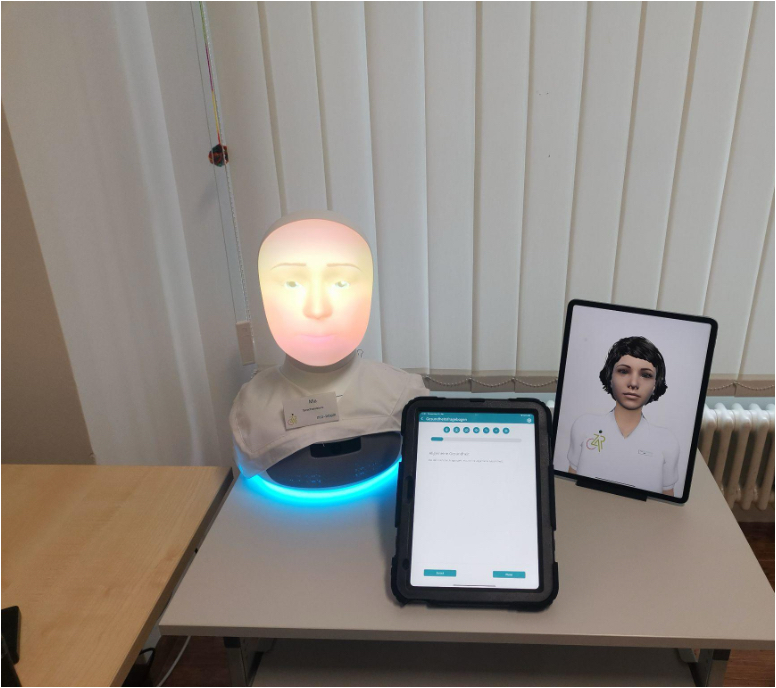
Collecting patient feedback is essential for evaluating medical treatments. One valuable method is using Patient Reported Outcome Measures (PROMs) questionnaires that capture patients’ experiences before and after care. Yet, challenges like language barriers, reading difficulties, or low motivation can prevent many from completing them, especially those from disadvantaged groups. The MIA-PROM project addresses this issue by developing a Multimodal Interactive Assistant (MIA) featuring a virtual and a physical assistant agent that guides patients through PROM questionnaires, explaining terms, answering questions, and encouraging completion in an accessible and engaging way. The project is a collaboration between four academic, industrial, and clinical partners and has a duration of 40 months. Our main contributions to the project were the development and integration of the virtual avatar assistant in the system, UX evaluation, and data analysis.
- Funders Federal Ministry of Education and Research
- Funding program AI-based assistance systems for process-accompanying health applications (KIAS)
- Funding amount 2.13 Million Euro
- Duration 2022–2025
Funding

Partners








Team
- Prof. Dr.-Ing. Jan-Niklas Voigt-Antons
Project Lead - Navid Ashrafi
Research Scientist
MIA-PROM is a collaborative effort, supported by the German Federal Ministry of Education and Research and involving academic, industrial, and clinical partners including Charité – University Berlin, University of Applied Sciences Munich, Technical University of Berlin, Hamm-Lippstadt University of Applied Sciences, Dexter Health GmbH, Acalta GmbH, ZAR Rehabilitation Center Berlin, and Seehof Rehabilitation Center Berlin. The project runs from 2022 to 2025 with a funding amount of 2.13 million euros. The key contributions from research teams have been the development and integration of the virtual avatar assistant, comprehensive user experience evaluation, and robust data analysis. By focusing on patient-centered communication and technological innovation, MIA-PROM aims to set a new standard for digital health data collection and improve medical care for diverse populations.
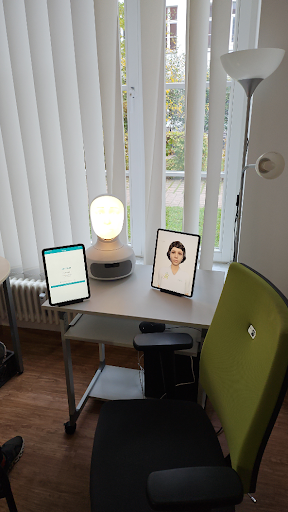
The MIA-PROM project is designed to revolutionize the way patient feedback is collected in clinical environments by utilizing advanced AI-driven assistance. Traditionally, Patient Reported Outcome Measures (PROMs) questionnaires are used to gather detailed data on treatment experiences and outcomes. However, the process is often hampered by barriers such as language difficulties, lack of understanding of medical terminology, and low motivation to participate—especially among disadvantaged groups. The MIA-PROM project addresses these challenges by introducing a Multimodal Interactive Assistant (MIA) that guides patients through the PROM process in a more engaging and accessible manner. This assistant appears both as a virtual avatar and a physical agent (Furhat robot), providing explanations of terms, answering questions, and motivating patients to complete the questionnaires fully, thereby improving the quality and inclusivity of the data collected.

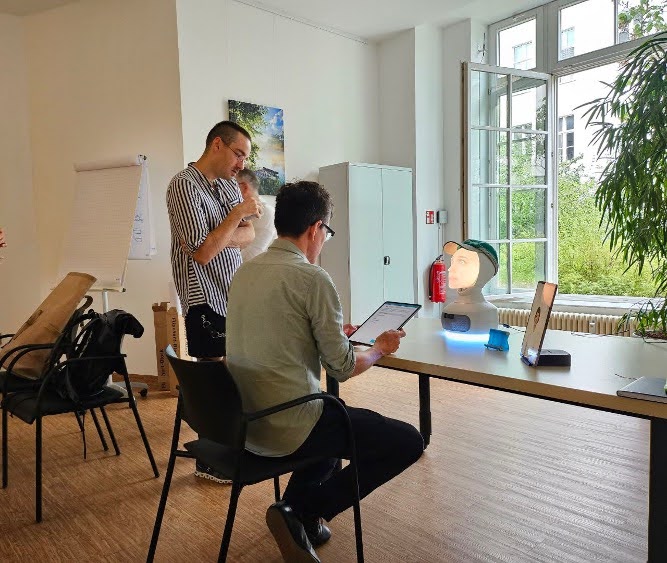
One of the core innovations of MIA-PROM lies in its commitment to accessibility and social inclusion. The assistant is designed to read questions aloud, translate medical terms into simpler language, and offer support tailored to individual patient needs. The project team has also adopted a participatory design approach, involving a patient advisory board throughout the development process to ensure that key design decisions reflect real patient perspectives. Workshops are used to gather feedback and discuss the preferred modality of the assistant whether a small robot-like agent for physical presence or a virtual avatar displayed on the screen. The goal is to determine which format most effectively encourages patient participation and data quality. Additionally, the system’s speech module is powered by artificial intelligence that learns and adapts during real interactions, continuously improving its effectiveness over time.
Publications
- Shaping the Metaverse: policy engagement with immersive technologies in the UK
McWilliams, G., Phillips, D., McEvoy, B., Phillips, E., Lydon, D., Chang, J. R., Voigt-Antons, J.-N., ... & Crooks, N. (2023). Shaping the Metaverse: policy engagement with immersive technologies in the UK. - What importance does outpatient care have for mobility in rural areas? Results from a GPS study among persons aged 75 and older
Haeger, C., Mümken, S., Spang, R. P., Brauer, M., Voigt-Antons, J.N. & Gellert, P. (2024, September). What importance does outpatient care have for mobility in rural areas? Results from a GPS study among persons aged 75 and older. Paper presented at the 23. Deutscher Kongress für Versorgungsforschung 2024. Potsdam, Germany. - Working with Mixed Reality in Public: Effects of Virtual Display Layouts on Productivity, Feeling of Safety, and Social Acceptability
Kaeder, J., Vergari, M., Biener, V., Kojic, T., Grubert, J., Möller, S. & Voigt-Antons, J.-N. (2024, October). Working with Mixed Reality in Public: Effects of Virtual Display Layouts on Productivity, Feeling of Safety, and Social Acceptability. Paper presented at the 23rd IEEE International Symposium on Mixed and Augmented Reality (ISMAR 2024), Greater Seattle Area, USA. - Multimodal User Experience in Extended Reality: Exploring Hand Tracking, Voice, and Passthrough Interactions
Kojic, T., Vergari, M., Warsinke, M., Ali, D., Möller, S. & Voigt-Antons, J.-N. (2025, March). Multimodal User Experience in Extended Reality: Exploring Hand Tracking, Voice, and Passthrough Interactions. Paper presented at the international workshop on IMmersive Mixed and Virtual Environment Systems (MMVE 2025), Stellenbosch, South Africa. - Investigating the impact of virtual element misalignment in collaborative Augmented Reality experiences
Vona, F., Hinzmann, S. L., Stern, M., Ćeranić, M., Grieshammer, D. K. & Voigt-Antons, J.-N. (2024, June). Investigating the impact of virtual element misalignment in collaborative Augmented Reality experiences. Paper presented at the 16th International Conference on Quality of Multimedia Experience (QoMEX 2024), Karlshamn, Sweden. https://doi.org/10.1109/QoMEX61742.2024.10598298 - Size Matters: The Impact of Avatar Size on User Experience in Healthcare Applications
Ashrafi, N., Vona, F., Hinzmann, S. L., Henning, J., Vergari, M., Warsinke, M., Moreira, C. P. & Voigt-Antons, J.-N. (2025, September). Size Matters: The Impact of Avatar Size on User Experience in Healthcare Applications. Paper presented at the 17th International Conference on Quality of Multimedia Experience (QoMEX 2025), Madrid, Spain. - Enabling Sustainable Everyday Mobility: The Role of E-Cargo Bikes in Urban and Rural Contexts
Voigt-Antons, J.-N, Ceranic, M. & Vona, F. (2025, June). Enabling Sustainable Everyday Mobility: The Role of E-Cargo Bikes in Urban and Rural Contexts. Poster presented at the International Conference on Human-Computer Interaction (HCII 2025). Gothenburg, Sweden.