DIDYMOS-XR
DIgital, DYnaMic and respOnsible twinS for XR
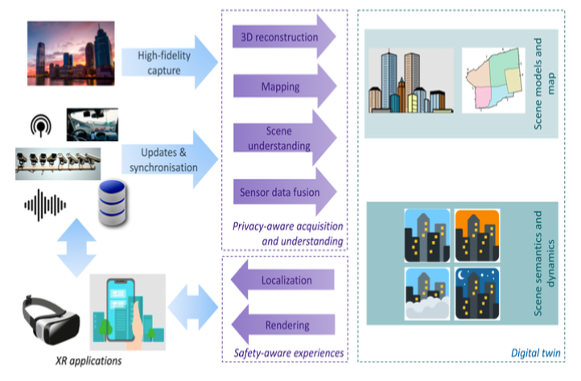
The vision of DIDYMOS-XR is to enable realistic and dynamic XR applications using AI. Therefore, the project focuses on advancing technologies for the creation of large-scale digital twins that are synchronized with the real world. DIDYMOS-XR explores and develops methods for reconstruction and mapping from heterogeneous inputs, including static and mobile sensors, AI-based data fusion, scene understanding, and rendering.
- Funders European Union
- Funding program HORIZON Action Grant Budget-Based
- Funding amount 5.92 Million Euro
- Duration 2023 - 12/2025
Funding
Partners






- Neàpolis



Team
- Prof. Dr.-Ing. Jan-Niklas Voigt-Antons
Project Lead - Francesco Vona, PhD
Senior Research Scientist - Miladin Ceranic
Research Scientist
DIDYMOS-XR: Dynamic and Responsible Digital Twins for XR
DIDYMOS-XR is a European research project focused on advancing the creation and use of digital twins—high-fidelity digital representations of real environments, machines, and processes. The project addresses a growing need for dynamic and continuously updated 3D models that can serve as the foundation for advanced Extended Reality (XR) applications in urban, industrial, and collaborative settings. By combining computer vision, sensor fusion, and artificial intelligence (AI), DIDYMOS-XR aims to transform static 3D scans into living, semantically rich digital twins that evolve in sync with the real world.
To achieve this vision, DIDYMOS-XR develops robust and scalable methods for 3D scene reconstruction from heterogeneous data sources such as LiDAR, RGB cameras, drones, and IoT sensors. These methods enable the integration of multi-temporal and multi-modal data—captured under different conditions—into coherent, accurate maps of real environments. AI-based semantic understanding allows the system to recognize and update objects automatically, linking sensor data to real-world functionality. The resulting framework supports XR applications that demand high realism, precision, and synchronicity, including industrial maintenance, city planning, safety training, and collaborative design.
Beyond technological innovation, DIDYMOS-XR follows a human-centred and ethically responsible approach. The project embeds privacy-by-design and ethics-by-design principles, ensuring that sensitive data are protected throughout capture, processing, and use. Validation takes place across five real-world use cases, where the technologies are co-designed and tested with end users to ensure usability, transparency, and societal benefit. Through this interdisciplinary effort, DIDYMOS-XR contributes to Europe’s leadership in ethical, AI-driven XR technologies and paves the way for scalable, trustworthy digital-twin ecosystems.
Work Package Structure
- WP1 – Project Management
Ensures the project’s technical, organisational, and financial success. Establishes communication and reporting structures, coordinates scientific activities, guarantees quality control, manages research data, and oversees periodic deliverables and compliance with the Grant Agreement.
- WP2 – User-Centric Development
Defines benchmarks and evaluation criteria for XR applications. Oversees ethics and GDPR compliance, adopting privacy- and ethics-by-design principles across all developments. Coordinates with the Ethics Advisory Board to ensure responsible innovation and user trust.
- WP3 – World Capture and Synchronisation
Develops methods to integrate data from multiple stationary and mobile sensors, combining low- and high-resolution inputs for large-scale 3D reconstruction. Investigates semantic and dynamic scene understanding and implements automatic synchronisation between physical environments and their digital twins.
- WP4 – Localisation, Mapping, and Rendering
Designs high-accuracy localisation algorithms using a coarse-to-fine multi-sensor approach. Researches methods for automatic map updates and adaptive rendering that optimise visual quality and performance across devices and viewing contexts.
- WP5 – XR Applications and Validation
Integrates the technologies developed in WP3 and WP4 into XR demonstrators across smart-city and industrial domains. Conducts user-centred validation experiments to assess technical performance, usability, Quality of Experience (QoE), and real-world impact.
- WP6 – Dissemination and Communication
Raises awareness among stakeholders and supports exploitation and innovation strategy. Implements the project’s dissemination and communication plan, engages industry and academic partners, and promotes the uptake of DIDYMOS-XR results through standardisation and outreach.
Use Cases
To demonstrate the scalability and versatility of DIDYMOS-XR technologies, the project develops and validates five complementary use cases integrating virtual and augmented reality across diverse environments:
- Digital Twin Creation
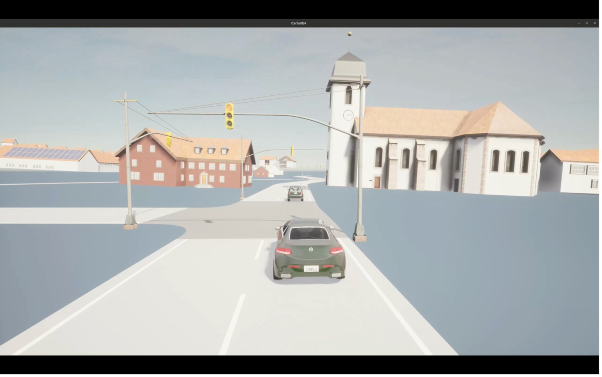
Builds the core digital twin by aggregating data from urban sensors (traffic lights, air quality, weather, cameras) and mobile platforms (cars, drones). The goal is to produce an accurate, up-to-date virtual model that continuously updates through sensor data, forming the foundation for all other applications.
- Tourism
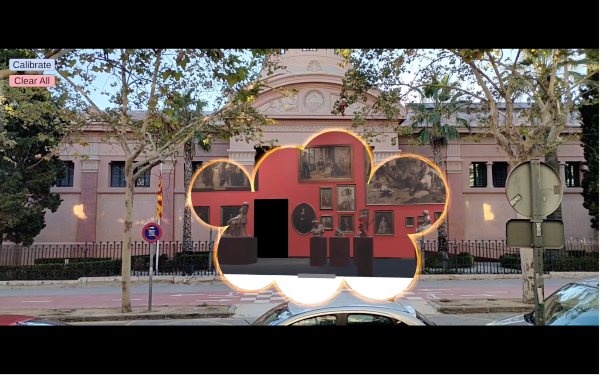
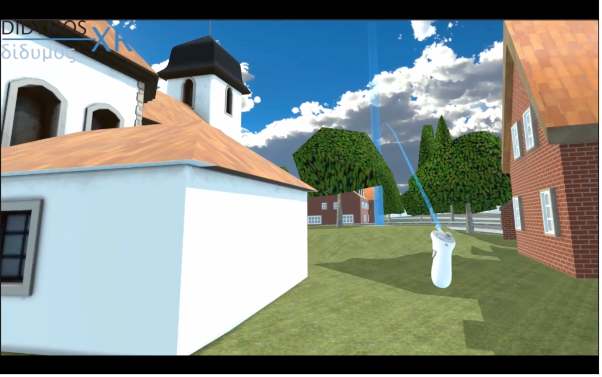
Delivers immersive tourism experiences through VR and AR. Remote users can explore virtual cities and view live information about crowd levels, traffic, and environmental conditions, while on-site users in Vilanova (Spain) and Etteln (Germany) can access contextual AR overlays providing navigation, schedules, and cultural information.
- City Maintenance
Uses sensor data and XR interfaces to improve urban infrastructure management. Applications include automatic detection of vandalism, litter, invasive vegetation, or damaged public furniture. Residents and city planners can visualise real-time maintenance alerts and resource needs.
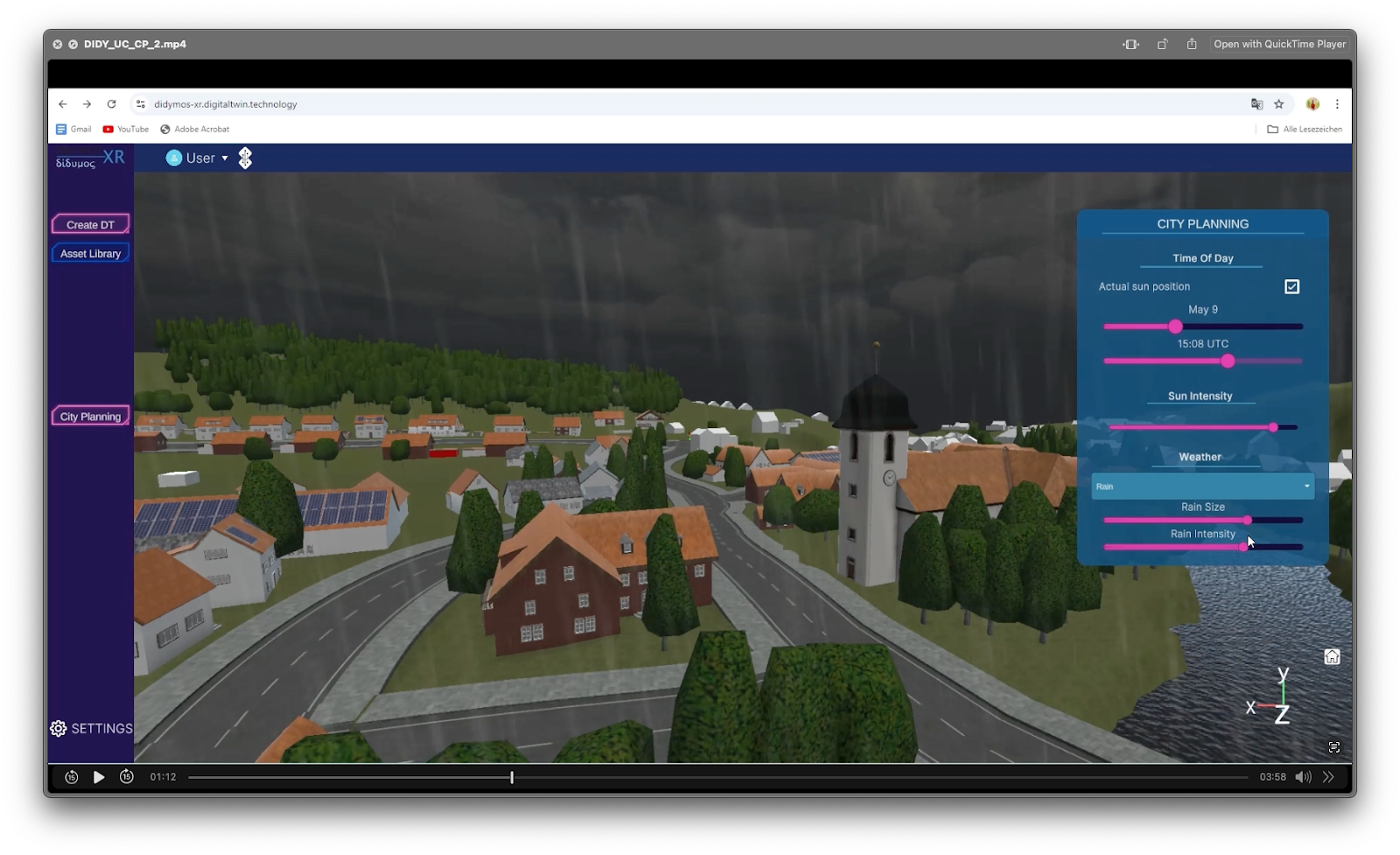
- City Planning
Enables planners to modify the digital twin and simulate future urban scenarios—from new traffic-light configurations and construction projects to changes in building layouts. The simulations help assess how urban interventions affect congestion, accessibility, and environmental quality.
- Industry
Supports industrial digital-twin workflows where human workers collaborate with autonomous robots. Using AR wearables or mobile devices, operators can detect scanning errors, update 3D factory models, or add points of interest (POIs) to guide maintenance and navigation tasks.
In the Blog
Two innovations developed in the DIDYMOS-XR project have been analyzed by the European Commission's Innovation Radar: a Validation Methodology for XR Digital Twin Applications and a User-Centered Design Methodology for XR Digital Twin Solutions. Hochschule Hamm-Lippstadt was named as a Key Innovator alongside TU Berlin. Read more in our blog post.
Publications
- Exploring the Effect of Heights and User Stance on User Experience in Extended Reality Climbing
Kojic, T., Kirchner, N., Vergari, M., Warsinke, M., Möller, S., Voigt-Antons, J.-N. (2025, September). Exploring the Effect of Heights and User Stance on User Experience in Extended Reality Climbing. Poster presented at the 17th International Conference on Quality of Multimedia Experience (QoMEX 2025), Madrid, Spain. - Influence of Interactivity in Shaping User Experience and Social Acceptability of Mobile Augmented Reality
Kojic, T., Vergari, M., Warsinke, M., Möller, S., Voigt-Antons, J.-N. (2025, March). Influence of Interactivity in Shaping User Experience and Social Acceptability of Mobile Augmented Reality. Paper presented at the workshop Social Interaction and Collaboration in eXtended Reality (SIC-XR 2025), Saint-Malo, France. - Digital Eyes: Social Implications of XR EyeSight
Vergari, M., Kojic, T., Wardah, W., Warsinke, M., Voigt-Antons, J.-N., Möller, S. & Spang, R. (2024, October). Digital Eyes: Social Implications of XR EyeSight. Paper presented at the 30th ACM Symposium on Virtual Reality Software and Technology (VRST 2024), Trier, Germany. https://doi.org/10.1145/3641825.3689526