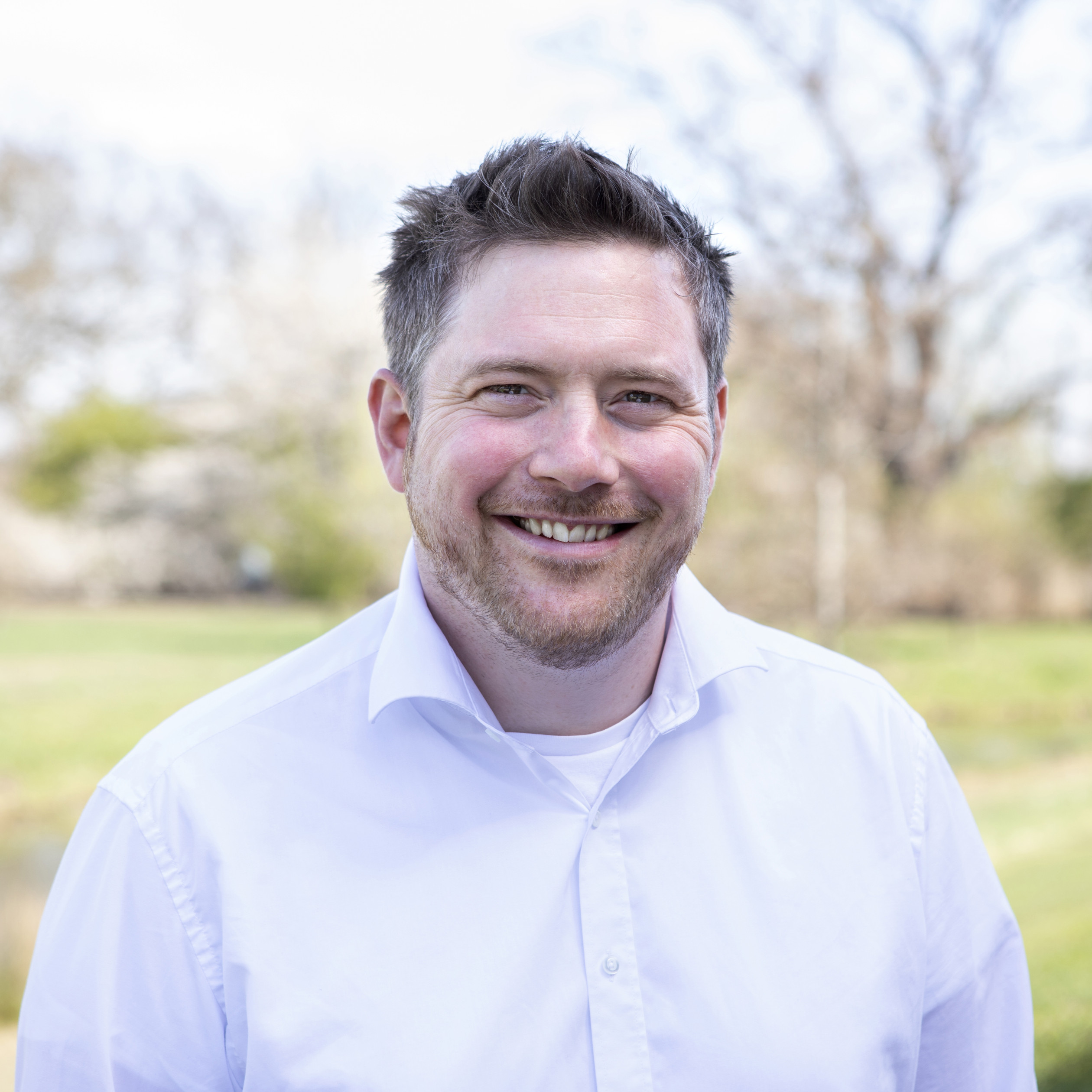
Prof. Dr.-Ing. Jan-Niklas Voigt-Antons
Professor of Applied Computer Science with a Focus on Immersive Media
I am professor of Applied Computer Science with a Focus on Immersive Media at Hamm-Lippstadt University of Applied Sciences, where I direct the Immersive Reality Lab (since 11/2021) and, since 2024, the HealthTech-HL research group. I am also a guest scientist at Technische Universität Berlin (since 11/2021), and since 11/2024 I co-lead the degree program Computer Visualization and Design. I am a member of HSHL's Department Council and its Commission for Quality Improvement.
My methodological foundation is a dual qualification: Diplom-Psychologe (TU Darmstadt, 2008) and Dr.-Ing. (TU Berlin, 2014, magna cum laude; dissertation published as a monograph by Springer). Before joining HSHL, I worked as a research scientist at Telekom Innovation Laboratories, at TU Berlin, at DFKI Berlin, and at INRS Montreal.
The Immersive Reality Lab comprises 11 research associates and 6 student assistants. Since 2015, I have raised €4.609 million in third-party funding across 22 projects and 10 funding lines, 20 of them as principal investigator. I currently supervise five doctoral projects.
Research interests:
- Human-computer interaction
- Extended reality (XR)
- Intelligent agents
- Psychophysiological and multimodal evaluation methods
Contact: +49 (0)2381 8789-914 · jan-niklas.voigt-antons@hshl.de
Appointments: Please book an appointment with me here.
Postal address:
Hamm-Lippstadt University of Applied Sciences, Marker Allee 76-78, 59063 Hamm, Germany
Visitor address:
Dr.-Arnold-Hueck-Straße 3, building L4, 59557 Lippstadt, Germany
Identifiers: ORCID 0000-0002-2786-9262 · Scopus Author ID 57194940462 · Google Scholar
Personal website: voigt-antons.de · complete list of publications · curriculum vitae
Citation Metrics
3,057 citations · h-index 29 · i10-index 85 (Google Scholar, as of 15 September 2026) — 1,709 citations · h-index 22 (Scopus, as of 15 September 2026).
Standardization
I contributed to ITU-T Recommendation P.812, Principles of subjective test methods for interactive virtual reality (VR) applications (2024), developed within ITU-T Study Group 12. In total, I have made 17 contributions to international standardization: ITU-T Study Group 12 (P.812, P.IntVR, P.PHYSIO, G.1035, P.GAME), ISO/IEC JTC 1/SC 29/WG 2 (MPEG, metaverse use cases), and DKE at DIN and VDE (digital qualification in healthcare).
View standardization publicationsAwards
- 2024 · Key Innovator, Innovation Radar of the European Commission (two innovations related to XR digital twins)
- 2025 · Best Paper Award, MMVE Workshop @ ACM MMSys
- 2023 · Best Journal Paper Award, IEEE Communications Society (MMTC)
- 2023 · Diversity and Societal Impact Award, QoMEX
- 2021 · Conference Paper Honorable Mention, IEEE VR
- 2024 · Sustainability Award of Volksbank Beckum-Lippstadt, special prize for a supervised bachelor's thesis
Academic Self-Organization
- Member of the Steering Committee, International Conference on Quality of Multimedia Experience (QoMEX), since 05/2026
- Technical Program Chair, MMVE 2026, Hong Kong
- General Chair, QoMEX 2022, Lippstadt
- Editorial Board, Virtual Worlds (MDPI), since 2025
- Editorial Board, Quality and User Experience (Springer), since 2021
- Advisory Board, TD-CHAT, Charité Berlin (2025–2027)
- Advisory Board, STOP-CSAM, Charité Berlin (2023–2025)
- Reviewer for IEEE TVCG, IEEE TMM, JMIR, Experimental Brain Research, Journal of Building Engineering, QoMEX, INTERSPEECH, ICASSP
Doctoral Mentoring
I currently supervise five doctoral candidates in the Immersive Reality Lab: Navid Ashrafi, Julia Schorlemmer, Sina Hinzmann, Juliane Henning, and Noureddine Hfaiedh.
Four doctoral procedures have been completed under my supervision or as reviewer, all at TU Berlin: Andres Pinilla (2022, binational cotutelle with the University of Technology Sydney), Tanja Kojić (2022), Jakob Korbel (2023, cross-faculty with Economics), and Maurizio Vergari (2024).
I also provided scientific mentorship, without a formal reviewer role, to three further doctoral projects: Arndt, Uhrig, and Spang.
In total, I have supervised 35 master's and 70 bachelor's theses since 2011.