Understanding Bystanders’ Tendency to Shoulder Surf Smartphones Using 360-degree Videos in Virtual Reality
Saad, A., Liebers, J., Gruenefeld, U., Alt, F. & Schneegass, S.
Proceedings of the 23rd International Conference on Mobile Human-Computer Interaction, 2021
Summary
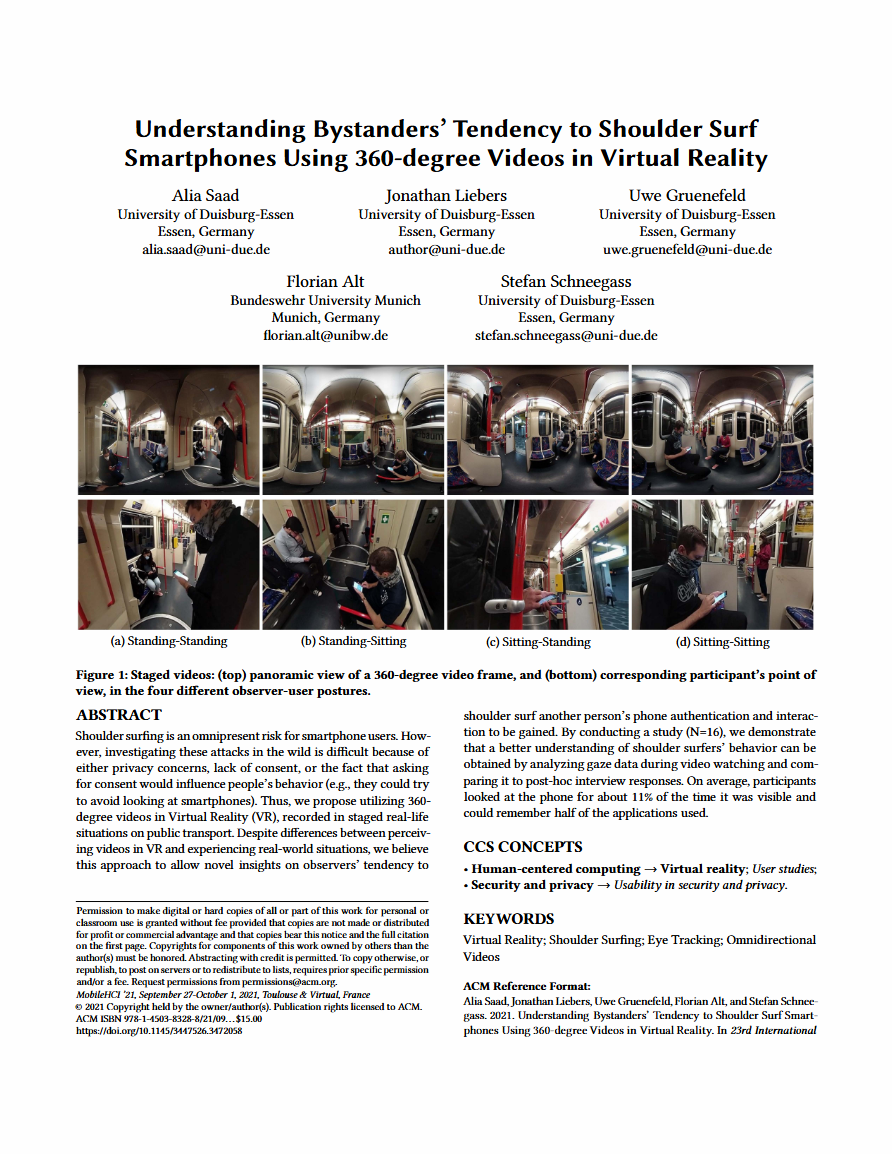
Shoulder surfing is an omnipresent risk for smartphone users. However, investigating these attacks in the wild is difficult because of either privacy concerns, lack of consent, or the fact that asking for consent would influence people’s behavior (e.g., they could try to avoid looking at smartphones). Thus, we propose utilizing 360-degree videos in Virtual Reality (VR), recorded in staged real-life situations on public transport. Despite differences between perceiving videos in VR and experiencing real-world situations, we believe this approach to allow novel insights on observers’ tendency to shoulder surf another person’s phone authentication and interaction to be gained. By conducting a study (N=16), we demonstrate that a better understanding of shoulder surfers’ behavior can be obtained by analyzing gaze data during video watching and comparing it to post-hoc interview responses. On average, participants looked at the phone for about 11% of the time it was visible and could remember half of the applications used.
Written for this site, the published abstract is at the DOI.
Cite as
Saad, A., Liebers, J., Gruenefeld, U., Alt, F. & Schneegass, S. (2021). Understanding Bystanders’ Tendency to Shoulder Surf Smartphones Using 360-degree Videos in Virtual Reality. In Proceedings of the 23rd International Conference on Mobile Human-Computer Interaction (pp. 1–8). https://doi.org/10.1145/3447526.3472058