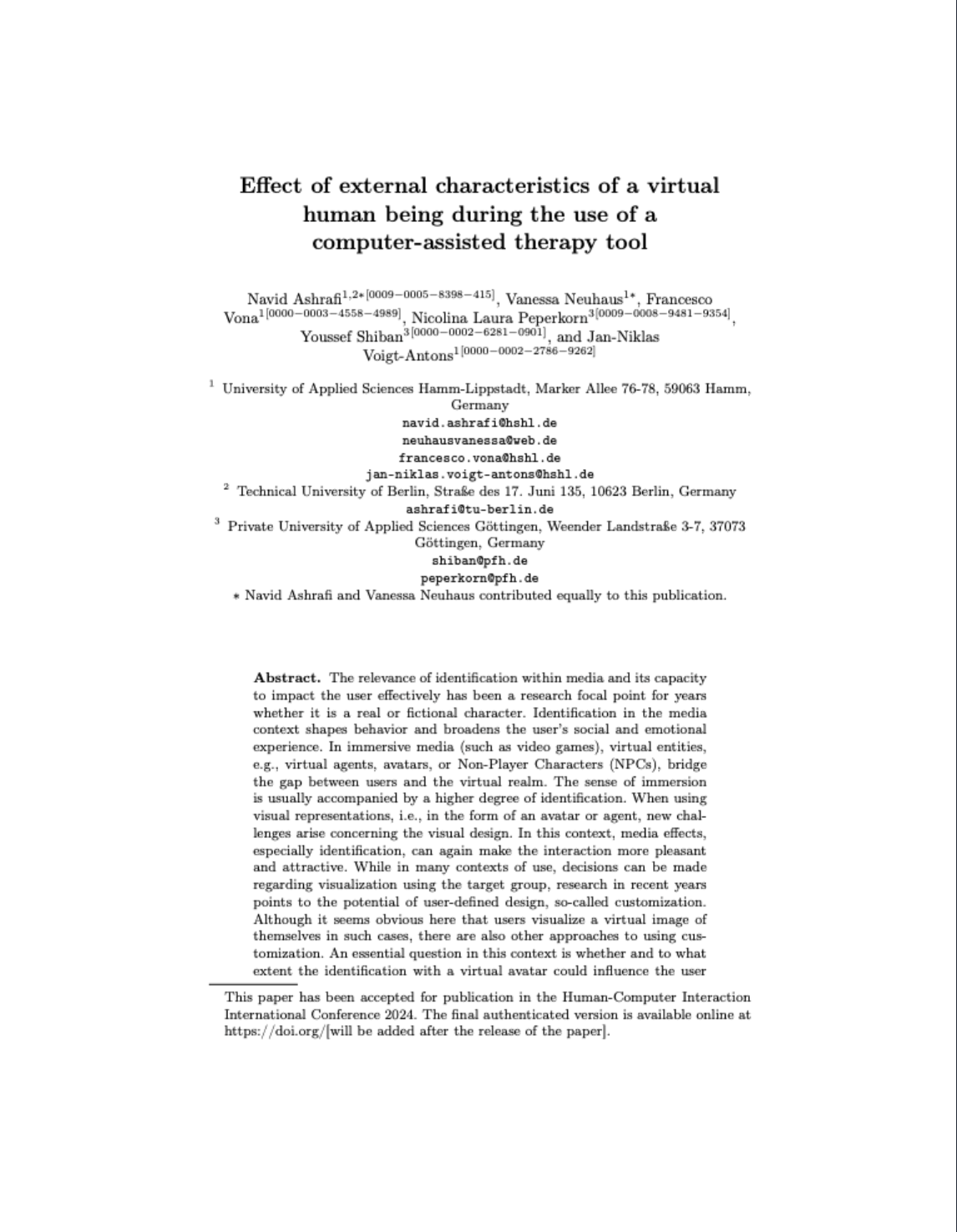
Effect of external characteristics of a virtual human being during the use of a computer-assisted therapy tool
Ashrafi, N., Neuhaus, V., Vona, F., Peric, N., Shiban, Y., & Voigt-Antons, J.-N.
Paper presented at the International Conference on Human-Computer Interaction (HCII 2024), Washington DC, USA, June 2024
Abstract
The relevance of identification within media and its capacity to impact the user effectively has been a research focal point for years whether it is a real or fictional character. Identification in the media context shapes behavior and broadens the user’s social and emotional experience. In immersive media (such as video games), virtual entities, e.g., virtual agents, avatars, or Non-Player Characters (NPCs), bridge the gap between users and the virtual realm. The sense of immersion is usually accompanied by a higher degree of identification. When using visual representations, i.e., in the form of an avatar or agent, new challenges arise concerning the visual design. In this context, media effects, especially identification, can again make the interaction more pleasant and attractive. While in many contexts of use, decisions can be made regarding visualization using the target group, research in recent years points to the potential of user-defined design, so-called customization. Although it seems obvious here that users visualize a virtual image of themselves in such cases, there are also other approaches to using customization. An essential question in this context is whether and to what extent the identification with a virtual avatar could influence the user experience of a psychological intervention. In this work, we explore the effect of visual similarity of a virtual anthropomorphic agent on the user experience in an intervention to reduce the effect of dysfunctional beliefs. In an experiment, 22 participants were asked to create a virtual agent in two groups, similar and dissimilar to them, and then, the avatar confronted them with their dysfunctional thoughts. The results show that the similarity of the virtual agent is not only associated with statistically significant increased identification but also with a positive influence on emotions and intrinsic motivation (more interest and enjoyment). This work contributes to the exploration of customization and identification, especially with virtual agents, and the potential implications for their visual design in the context of computer-assisted therapy tools.
Cite as
Ashrafi, N., Neuhaus, V., Vona, F., Peric, N., Shiban, Y., & Voigt-Antons, J.-N. (2024, June). Effect of external characteristics of a virtual human being during the use of a computer-assisted therapy tool. Paper presented at the International Conference on Human-Computer Interaction (HCII 2024). Washington DC, USA. https://doi.org/10.1007/978-3-031-60428-7_1