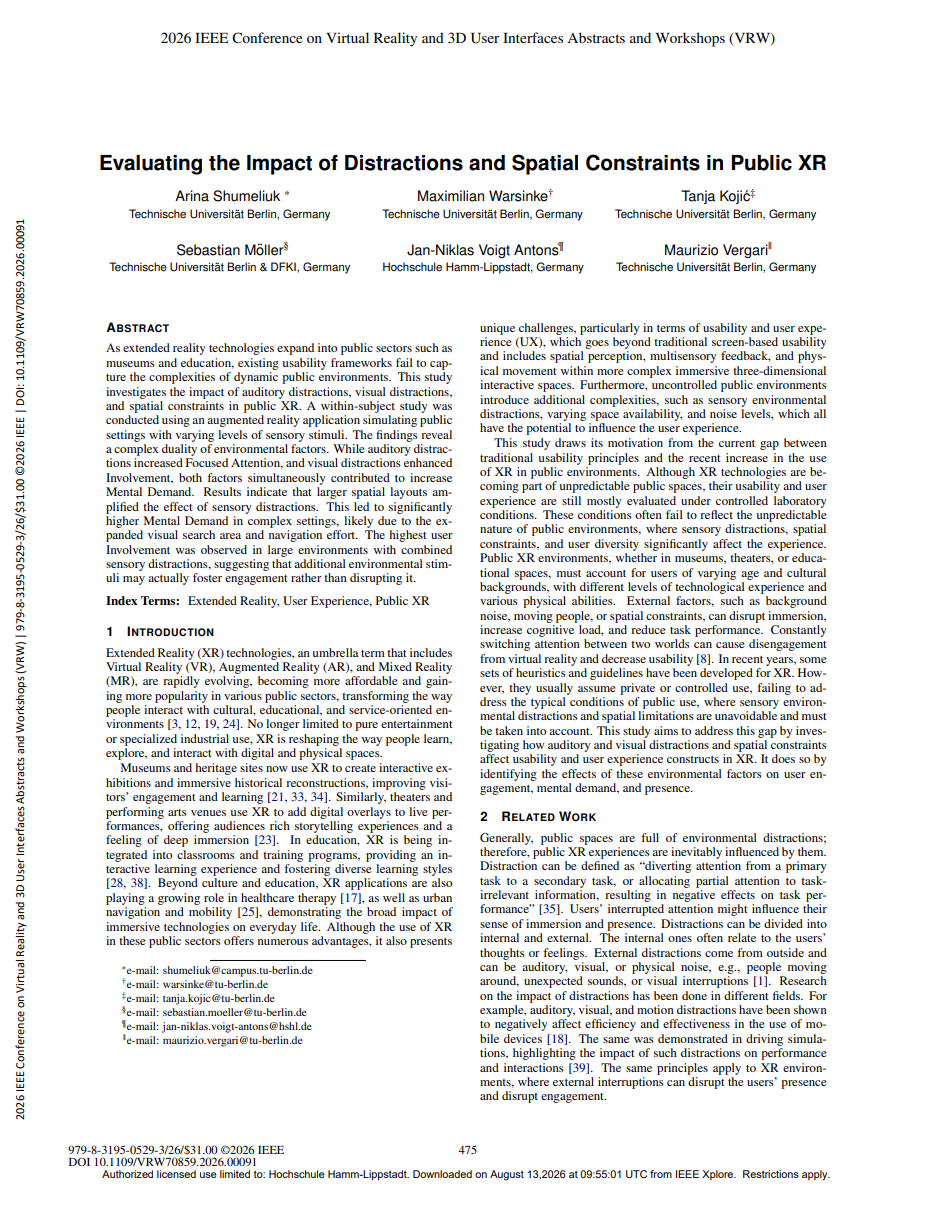
Evaluating the Impact of Distractions and Spatial Constraints in Public XR
Shumeliuk, A., Warsinke, M., Kojic, T., Möller, S., Voigt-Antons, J.-N. & Vergari, M.
Paper presented at the workshop Social Interaction and Collaboration in eXtended Reality (SIC-XR 2025), Daegu, Korea, March 2026
Abstract
As extended reality technologies expand into public sectors such as museums and education, existing usability frameworks fail to capture the complexities of dynamic public environments. This study investigates the impact of auditory distractions, visual distractions, and spatial constraints in public XR. A within-subject study was conducted using an augmented reality application simulating public settings with varying levels of sensory stimuli. The findings reveal a complex duality of environmental factors. While auditory distractions increased Focused Attention, and visual distractions enhanced Involvement, both factors simultaneously contributed to increase Mental Demand. Results indicate that larger spatial layouts amplified the effect of sensory distractions. This led to significantly higher Mental Demand in complex settings, likely due to the expanded visual search area and navigation effort. The highest user Involvement was observed in large environments with combined sensory distractions, suggesting that additional environmental stimuli may actually foster engagement rather than disrupting it.
Cite as
Shumeliuk, A., Warsinke, M., Kojic, T., Möller, S., Voigt-Antons, J.-N. & Vergari, M. (2026, March). Evaluating the Impact of Distractions and Spatial Constraints in Public XR. Paper presented at the workshop Social Interaction and Collaboration in eXtended Reality (SIC-XR 2025), Daegu, Korea.