Auditory BCIs for Visually Impaired Users: Should Developers Worry About the Quality of Text-to-Speech Readers?
Laghari, K., Gupta, R., Arndt, S., Antons, J.-N., Möller, S. & Falk, T. H.
Paper presented at the 5th International BCI Meeting, Pacific Grove, CA, USA, June 2013
Abstract
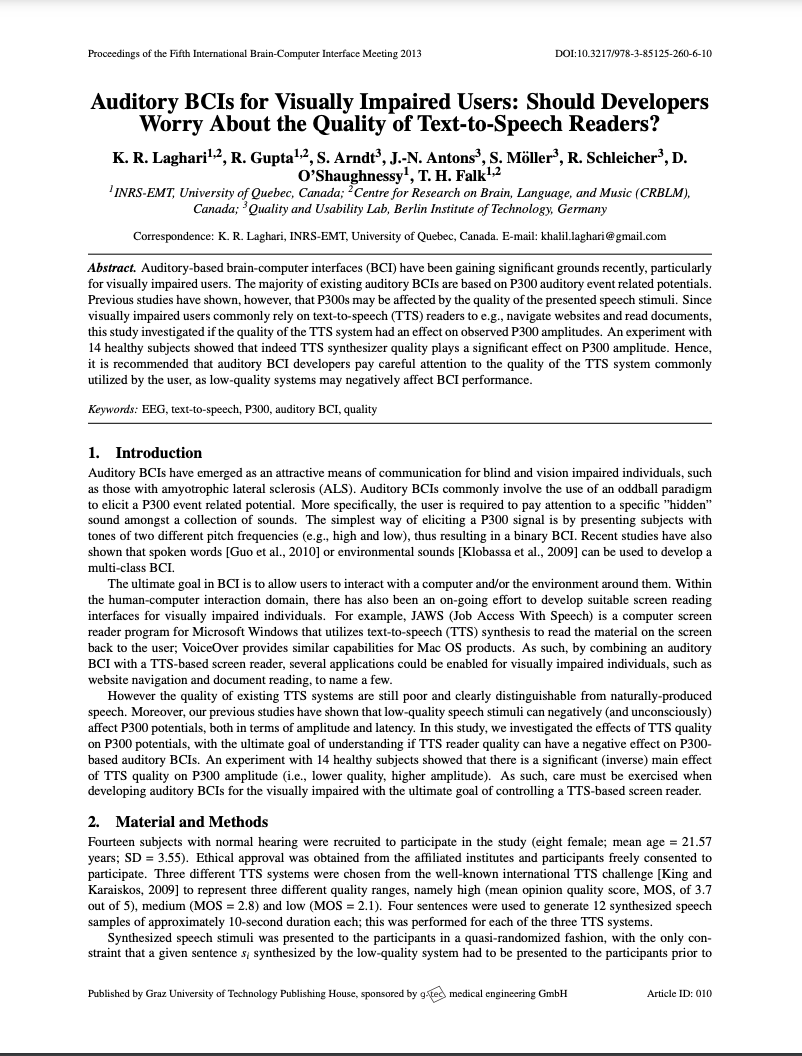
Auditory-based brain-computer interfaces (BCIs) have been gaining significant traction, particularly for visually impaired users. Most existing auditory BCIs rely on P300 auditory event-related potentials. However, prior research has shown that P300 responses can be influenced by the quality of the auditory stimuli. Given that visually impaired users often depend on text-to-speech (TTS) readers for tasks such as navigating websites or reading documents, this study explores whether TTS quality affects P300 amplitudes. An experiment with 14 healthy participants revealed that TTS synthesizer quality significantly impacts the P300 component. As a result, it is recommended that developers of auditory BCIs carefully consider the TTS systems used by their target users, since lower-quality TTS outputs may negatively impact BCI performance.
Cite as
Laghari, K., Gupta, R., Arndt, S., Antons, J.-N., Möller, S. & Falk, T. H. (2013, June). Auditory BCIs for Visually Impaired Users: Should Developers Worry About the Quality of Text-to-Speech Readers?. Paper presented at the 5th International BCI Meeting, Pacific Grove, CA, USA.