The Three-Body Problem of Collaboration: Effects of Asymmetric Physical Co-Presence in Augmented Reality
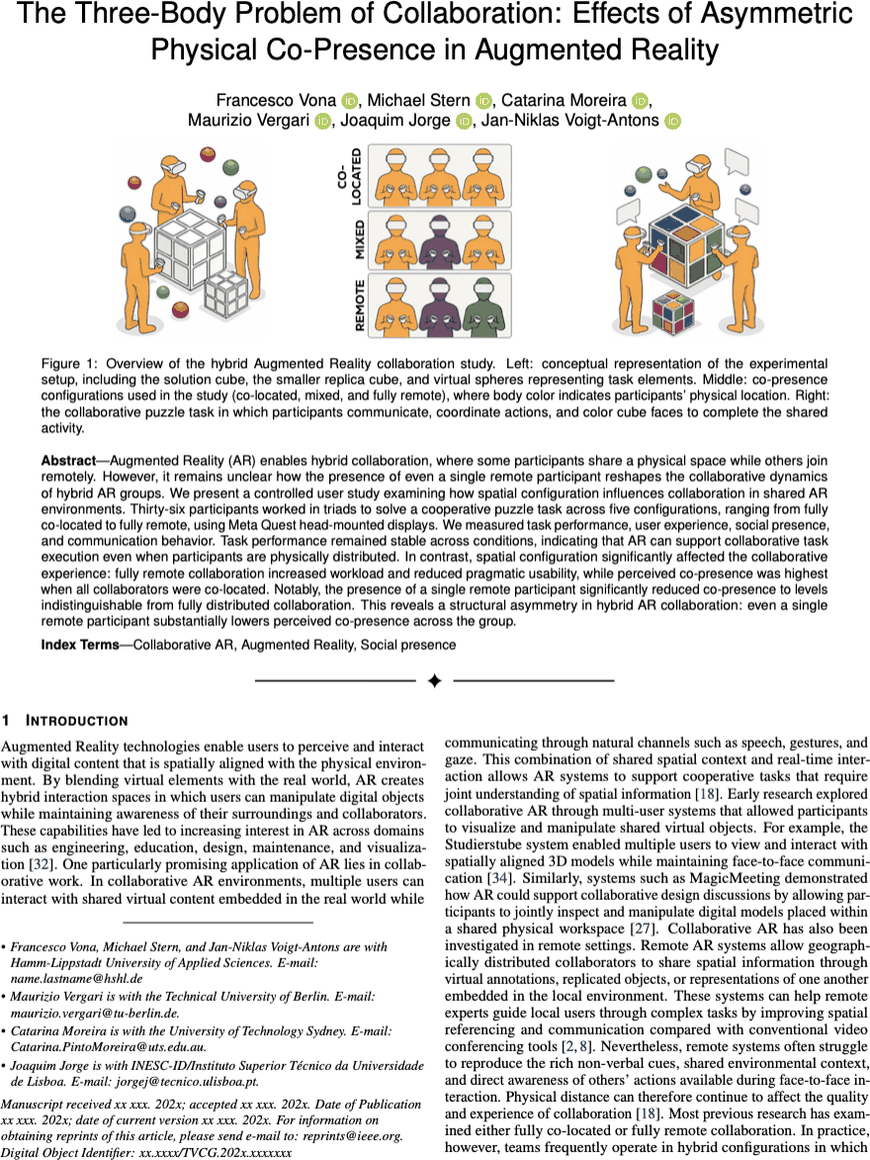
Vona, F., Stern, M., Moreira, C., Vergari, M., Jorge, J., & Voigt-Antons, J.-N.
Paper presented at the 25th IEEE International Symposium on Mixed and Augmented Reality (ISMAR 2026), Bari, Italy
Abstract
Augmented Reality (AR) enables hybrid collaboration, where some participants share a physical space while others join remotely. However, it remains unclear how the presence of even a single remote participant reshapes the collaborative dynamics of hybrid AR groups. We present a controlled user study examining how spatial configuration influences collaboration in shared AR environments. Thirty-six participants worked in triads to solve a cooperative puzzle task across five configurations, ranging from fully co-located to fully remote, using Meta Quest head-mounted displays. We measured task performance, user experience, social presence, and communication behavior. Task performance remained stable across conditions, indicating that AR can support collaborative task execution even when participants are physically distributed. In contrast, spatial configuration significantly affected the collaborative experience: fully remote collaboration increased workload and reduced pragmatic usability, while perceived co-presence was highest when all collaborators were co-located. Notably, the presence of a single remote participant significantly reduced co-presence to levels indistinguishable from fully distributed collaboration. This reveals a structural asymmetry in hybrid AR collaboration: even a single remote participant substantially lowers perceived co-presence across the group.
Cite as
Vona, F., Stern, M., Moreira, C., Vergari, M., Jorge, J., & Voigt-Antons, J.-N. (2026). The Three-Body Problem of Collaboration: Effects of Asymmetric Physical Co-Presence in Augmented Reality. Paper presented at the 25th IEEE International Symposium on Mixed and Augmented Reality (ISMAR 2026), Bari, Italy.