VRChat Said No to an AI Label. Its Reasoning Points to Where Labelling Belongs
In October, VRChat surveyed its users about AI-generated content. 21,595 people replied in a week, and 95% wanted some kind of AI label. On 28 October, VRChat said no. It will not add an “AI-generated” label or AI filters. Its stated reasons: some creators would label honestly while others would pass off AI-assisted work as handmade, and a label could encourage amateur detective work and harassment of creators, including those who use no AI at all. Instead it has banned misleading thumbnails, plans likes and dislikes for worlds, and is considering a “Human-authored” mark. Road to VR reported the backlash on 2 November. On Steam, the rating of recent reviews fell to “Mostly Negative” (about 4,000 reviews, 33% positive over 30 days), and the overall rating from “Mostly Positive” to “Mixed”.
The usual reading is that a platform ignored its users. We think VRChat’s reasoning is more interesting than that, because it is right about the problem and wrong about the conclusion.
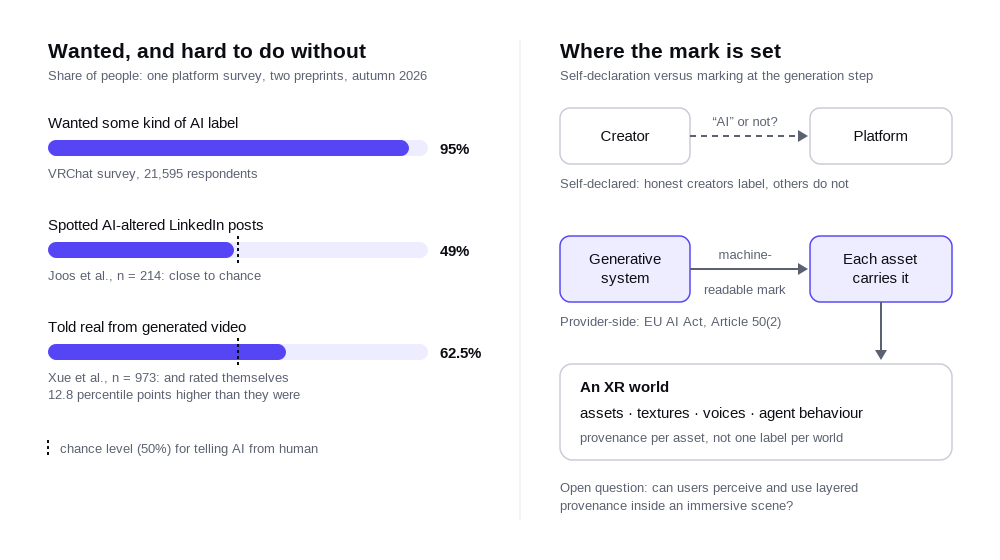
It is right that a label is only as good as whoever applies it. A self-declared label in a creator community will be gamed. Two preprints submitted on 4 November show why that matters. In a pre-registered study with 214 participants (Joos et al., arXiv 2611.06660), readers identified AI-altered LinkedIn posts with 49% accuracy, close to chance level. When unsure, they assumed a human wrote the post, and AI alteration had no detectable effect on perceived trust. In a second study with 973 participants (Xue et al., arXiv 2611.05844), people judged real vs. generated videos at 62.5% accuracy but placed themselves 12.8 percentile points higher than they were. Overprecision, a separate form of overconfidence, was linked to a greater intention to share and to classifying videos as human-made.
So in these two studies, people detected AI content poorly, and in the video study they overrated their own ability. For many readers, a label may therefore be one of the few available signals. A missing label isn’t neutral: when unsure, readers default to assuming a human made the content.
Mark at the generation step
This is where we disagree with VRChat’s conclusion. The answer to dishonest self-labelling is to put the mark at the generation step, not to rely on self-declaration alone. That is the logic of the EU AI Act. Article 50(2) puts the marking duty on providers of generative systems, as machine-readable marks. Separate labelling duties apply to deployers of deepfakes. The Commission’s final Code of Practice on marking and labelling of AI-generated content (June 2026), a voluntary instrument, sets out how.
Article 50 has applied since 2 August 2026. For generative systems already on the market before that date, the marking duty of Article 50(2) applies from 2 December 2026 (Commission FAQ). Some of the tools VRChat creators use are generative systems of this kind. Once provider-side marks exist, a platform could in principle read them rather than ask creators to self-declare.
Provenance per asset, not per world
For XR there is an extra layer. A world isn’t a single post. It is assets, textures, voices and agent behaviour, each of which may or may not be generated. “Human-authored” for a whole world is probably meaningless. Provenance per asset is not. Whether users can perceive and use that kind of layered provenance inside an immersive scene is an open HCI and QoE question, and, to our knowledge, it has not been measured yet.
Our research on quality of experience
References
- European Commission. (2026, June 10). Commission publishes Code of Practice on marking and labelling AI-generated content [Press release]. digital-strategy.ec.europa.eu
- European Commission. (2026, July 24). Transparency obligations under Article 50 of the AI Act [FAQ]. digital-strategy.ec.europa.eu
- European Parliament and Council of the European Union. (2024). Regulation (EU) 2024/1689 of 13 June 2024 laying down harmonised rules on artificial intelligence (Artificial Intelligence Act). Official Journal of the European Union, L, 2024/1689. data.europa.eu
- Hayden, S. (2026, November 2). “VRChat” faces user backlash after rejecting “AI-generated” content label. Road to VR. roadtovr.com
- Joos, T. C., Bouleimen, A., Hannák, A., and Pagan, N. (2026). Perceived trust and transparency in AI-altered vs. human-written LinkedIn posts. arXiv preprint arXiv:2611.06660. arxiv.org
- VRChat. (2026, October 28). Where we’re landing on AI in VRChat [Forum post]. VRChat Ask Forum. ask.vrchat.com
- Xue, H., Qian, S., Calabrese, C., Shen, C., Taylor, L., and Wang, Y. (2026). Sure enough to share? Overconfidence in GenAI video discernment is associated with sharing intentions. arXiv preprint arXiv:2611.05844. arxiv.org