Europe Is About to Define "Social Acceptability" for Smart Glasses. HCI Has Been Measuring It for Years
On 2 October, Hans Anders, one of the largest optical chains in the Netherlands, stopped selling Meta's camera glasses in all its Dutch and Belgian stores and online. Online retailer Wehkamp followed. The Dutch data protection authority (AP) warned that camera glasses are "not always easy to notice in public spaces" and said it is looking at further measures. The Dutch government, however, is not moving towards a ban. Justice state secretary Claudia van Bruggen pointed out that the AP had received six reports and one complaint, and said the government would wait for a report from the European Data Protection Board, expected later this year.
That report is worth paying attention to, because of its subject. According to Politico Europe in June, the EDPB commissioned it on the social acceptability of smart glasses. That is a regulatory body taking up a term that human–computer interaction researchers have been operationalising for years. It is also where this debate is likely to go wrong.
The trouble with complaint counts
Start with the government's number. Six reports and one complaint sounds like a quiet problem. But it measures the wrong thing, and it does so in a systematically biased way. You can only complain about being recorded if you noticed. The property at issue, a camera that bystanders don't detect, is the same property that suppresses the complaints. The data is censored by the very effect it is meant to measure.
Three weeks earlier, Hamburg's data protection commissioner published a technical and legal review of the Ray-Ban Meta glasses. It described the recording indicator as glowing only dimly during AI interactions and as essentially invisible outdoors or in direct sunlight. Meta, for its part, maintains that the light flashes and cannot be switched off. Both statements can be true at once, and that is the point: whether an indicator works is a perceptual question, not a hardware question.
Perceptual questions have a method
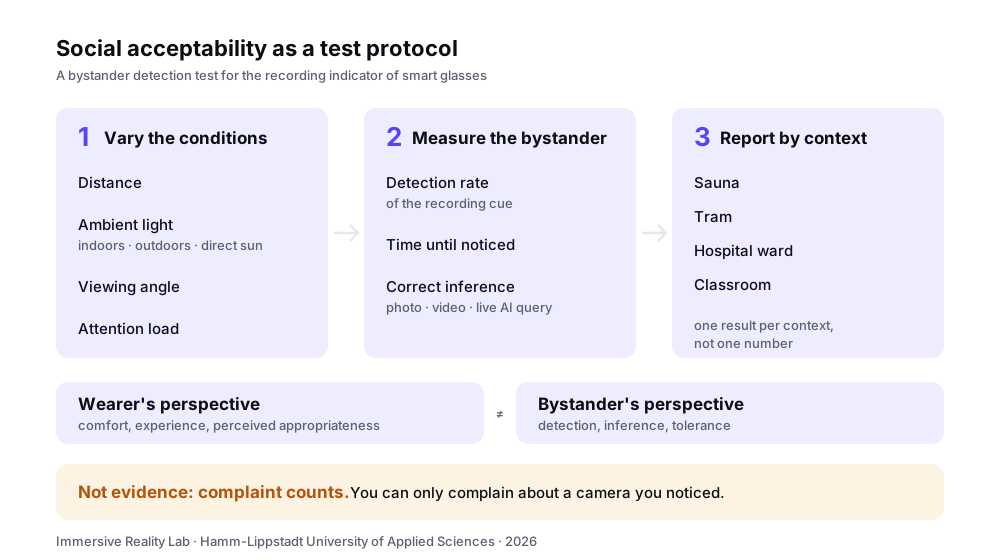
In quality-of-experience research we don't ask whether a codec is "acceptable." We define test conditions, recruit naïve observers, and measure detection and ratings under controlled variation. For smart glasses, the bystander version is almost embarrassingly simple to specify: detection rate of the recording cue as a function of distance, ambient light, viewing angle and attention load. Add how long it takes a bystander to notice, and whether they correctly infer what is being captured (photo, video, a live AI query). A few hundred participants and a standardised protocol would give regulators a curve instead of an anecdote.
Acceptability depends on context
The second lesson from the literature is that acceptability is not a property of the device. It depends on context: who is around, what the wearer is doing, and whether the interaction is visible. In our own work on AR in public settings, we studied how the social environment and the focus of interaction shape both the wearer's experience and how acceptable the use appears. Earlier work of ours treated user experience and social acceptability as separate outcomes, measured side by side. Neither the wearer's comfort nor a bystander's tolerance transfers from one setting to another. A sauna, a tram, a hospital ward and a classroom are different measurement conditions.
What the EDPB should put in its test plan
For the EDPB report to produce actionable guidance, social acceptability needs to be treated as a protocol question, not a qualitative judgement. Separate the wearer's perspective from the bystander's. Measure detectability of the indicator, not just its existence. Report results by context, not as one number. And don't count complaints as evidence that there is no problem.
This matters beyond Meta. Samsung and Google's Android XR glasses are passing certification, and Apple is working on its own. Indicator design is about to become a de-facto standard in every one of them. If nobody defines how to test it, the industry will define it by what's cheapest to ship.
Our research on extended reality
Our research on quality of experience
References
- Cocchia, L., Vergari, M., Kojic, T., Vona, F., Möller, S., Garzotto, F., and Voigt-Antons, J.-N. (2024). The impact of social environment and interaction focus on user experience and social acceptability of an augmented reality game. QoMEX 2024. doi.org/10.1109/QoMEX61742.2024.10598279
- Liu, Y. (2026, October 3). The Netherlands considers banning Meta AI glasses; some retailers have pulled them [in Chinese]. Nweon, citing Business Insider. news.nweon.com/143360
- Neerman, P. (2026, October 2). Privacyrel rond Meta-bril dwingt Hans Anders tot verkoopstop. RetailDetail BE. retaildetail.be
- Politico Europe (2026, June 8). New privacy frontier: Europe eyes crackdown on smart glasses. politico.eu
- Rijo, L. (2026, September 10). Hamburg regulator finds Ray-Ban Meta glasses expose bystanders without consent. PPC Land. ppc.land
- Vergari, M., Kojić, T., Vona, F., Garzotto, F., Möller, S., and Voigt-Antons, J.-N. (2021). Influence of interactivity and social environments on user experience and social acceptability in virtual reality. IEEE VR 2021. doi.org/10.1109/VR50410.2021.00096