New in Digital Health: Does an AI Assistant Make Patient Questionnaires Easier?
Our new article has been published in Digital Health: "Multimodal interactive assistance for inclusive collection of patient-reported outcome measures: A pragmatic cross-over randomised controlled trial" by Manuela Marquardt, Philipp Graf, Stefan Hillmann, Jan-Niklas Voigt-Antons, Philipp Harnisch, Navid Ashrafi, Diego Compagna and Jan C. Zoellick. It reports the central trial of the MIA-PROM project and is open access.
Patient-reported outcome measures (PROMs) are questionnaires in which patients describe their own health and how a treatment affects it. They support patient-centred care and quality improvement, but completing them can be a burden, especially for people with reading difficulties, language barriers or limited concentration. In MIA-PROM we developed a multimodal assistant that uses AI speech processing so that patients can complete the questionnaire interactively. It came in three embodiments, a robot, a virtual agent and a voice-only assistant, each paired with a questionnaire tablet and refined step by step in participatory co-design.
The study
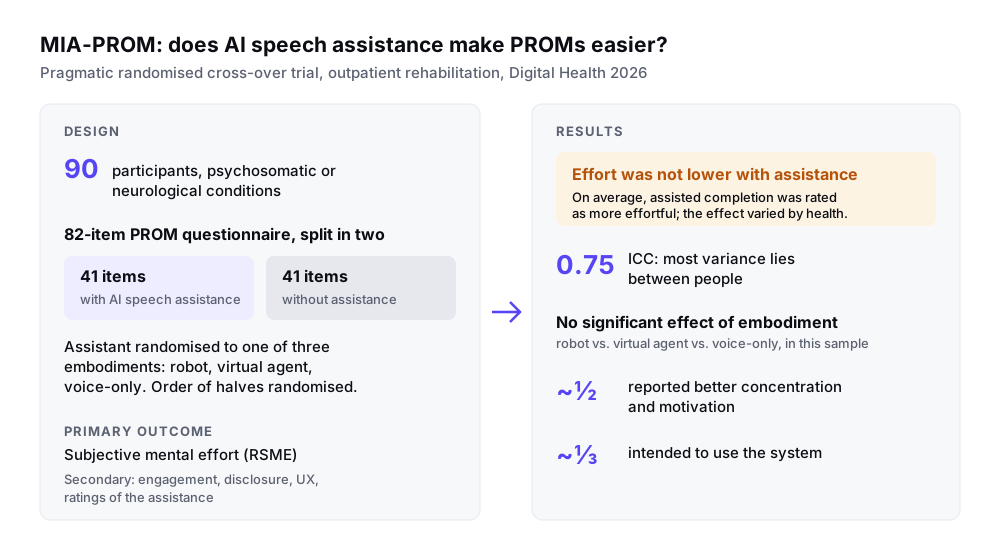
The trial took place at a German outpatient rehabilitation clinic. 90 participants with psychosomatic or neurological conditions completed an 82-item PROM questionnaire split into two halves of 41 items: one half with AI speech assistance, the other without. The order of the halves and the embodiment of the assistant were randomised. The primary outcome was subjective mental effort, measured with the Rating Scale Mental Effort (RSME). Secondary outcomes included engagement, disclosure, user experience and ratings of the assistance.
What we found
- On average, the assistance did not make the questionnaire feel easier. Assisted completion was associated with higher subjective effort than unassisted completion, and this effect varied with participants' general health.
- Most of the variance lay between people rather than between conditions (ICC = 0.75). Effort was higher with a psychosomatic indication, poorer general health and concentration barriers, and lower for participants who were more open to technology.
- Whether the assistant was a robot, a virtual agent or voice-only made no significant difference in this sample.
- Evaluations of the system were heterogeneous: about half of the participants reported improved concentration and motivation, and about one third said they would use the system.
What this means
A trial that does not confirm its hypothesis on the primary outcome is still informative. An assistant is not automatically a relief: for some patients, the dialogue helps them stay focused and keep going; for others, it may be one more thing to process. The conclusion is not to drop assistance, but to offer it flexibly and as an option, adapted to the needs of the people using it and implemented with equity in mind, rather than making it the default for everyone.
In MIA-PROM, our lab contributed the virtual agent, the UX evaluation and data analysis. How participants experienced the embodied and non-embodied agents is described in a companion article in Virtual Worlds.
Many thanks to all participants, to the clinic team and to our partners in MIA-PROM. The project was funded by the German Federal Ministry of Education and Research (BMBF).
Our research on assistive technologies and digital health
References
- Marquardt, M., Graf, P., Hillmann, S., Voigt-Antons, J.-N., Harnisch, P., Ashrafi, N., Compagna, D., and Zoellick, J. C. (2026). Multimodal interactive assistance for inclusive collection of patient-reported outcome measures: A pragmatic cross-over randomised controlled trial. Digital Health, 12, 20552076261484852. doi.org/10.1177/20552076261484852
- Ashrafi, N., Graf, P., Marquardt, M., Harnisch, P., Hillmann, S., Ploner, N., Compagna, D., Cirit, E., Papst, L., and Voigt-Antons, J.-N. (2026). Multimodal assistance in rehabilitation: User experience of embodied and non-embodied agents for collecting patient-reported outcome measures. Virtual Worlds, 5(1), 15. doi.org/10.3390/virtualworlds5010015