Virtual Reality as a Standardised Stressor: What a New Scoping Review Means for Wearable Validation
Every smartwatch now shows a stress score. Almost none of those scores has been validated against a stressor that is both experimentally controlled and ecologically plausible. Established laboratory paradigms such as the Trier Social Stress Test satisfy the first criterion but are resource-intensive, require trained personnel, and are difficult to replicate across sites. Ambulatory field recordings offer ecological plausibility but sacrifice experimental control. Immersive virtual reality has long been proposed as a bridge between these two extremes; a systematic evaluation of whether it delivers on that promise has, until recently, been absent.
A scoping review published in Behavior Research Methods on 18 September 2026 addresses this gap directly. After screening five databases, the authors retained 110 studies and organised the identified VR stressors into three primary categories: social-evaluative, environmental, and cognitive, spanning 11 distinct task types. Among physiological measures, heart rate was recorded in 59% of studies, skin conductance level in 39%, and both HRV parameters and salivary cortisol in 29% each. Two tasks stood out for their consistent and robust physiological reactivity: the VR Trier Social Stress Test and the high-altitude task, typically implemented as a plank-over-void paradigm with graded elevation.
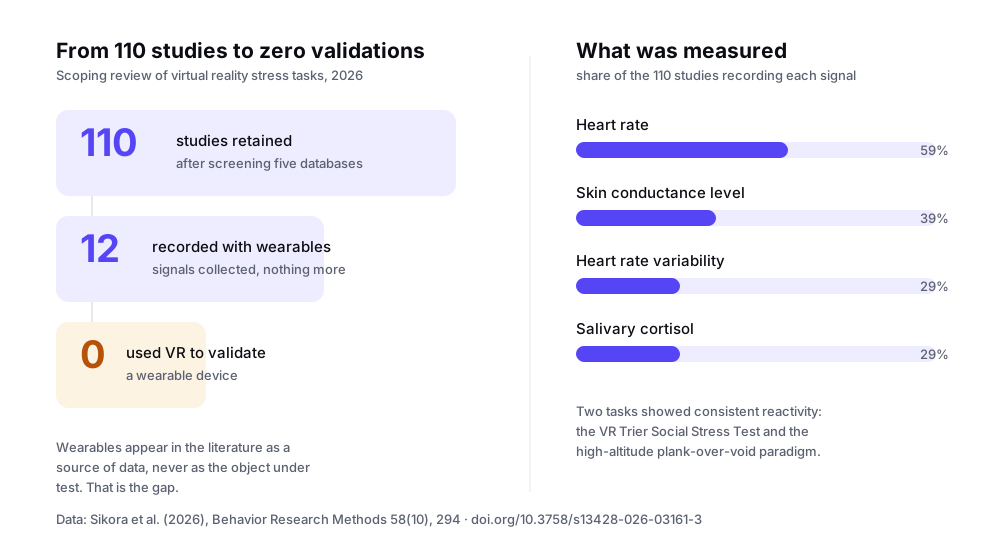
The review's most consequential finding for wearable research is a negative one: although 12 of the 110 studies incorporated wearable devices to record physiological signals, none employed VR stress induction as a validation instrument in the strict methodological sense. Wearables were used to collect data; they were not the object of systematic construct or convergent validity assessment within a controlled VR paradigm.
What closing the gap requires
The review's findings point to three methodological requirements that must be addressed before VR can serve as a credible validation platform.
Graded stressor intensity. A validation protocol must vary stimulus intensity in a controlled, parametric manner, for instance through systematic increases in virtual altitude or audience size. A single on-off contrast cannot distinguish a device that responds appropriately across a dynamic range from one that only registers large effects.
Presence and cybersickness as experimental covariates. VR-specific factors such as cybersickness and unfamiliarity with head-mounted displays generate physiological signals that may be confounded with stress-related reactivity. In a validation context, this constitutes an uncontrolled stimulus rather than a measurement artefact. Brief validated questionnaires administered within the VR session can capture these covariates without substantially disrupting immersion.
An independent reference signal. Valid wearable assessment requires concurrent recording by a gold-standard reference, specifically ECG-derived HRV and laboratory-grade EDA, time-locked to scene events and parametric manipulations. This is standard practice in psychophysiology research and should be a minimum requirement for any claim of wearable validation.
Why this matters beyond the lab
Physiological stress and recovery indices are entering clinical care pathways, occupational health monitoring, and insurance-adjacent products. Contactless sensing modalities, including radar-based and camera-based vital sign estimation, are on a similar trajectory. Our own work on psychophysiology-based quality of experience assessment and on the physiological basis of consumer stress scores has encountered the same validation problem from a different angle.
When regulatory scrutiny arrives, a documented, reproducible VR stressor battery will constitute substantially stronger evidence than correlational field data. The Sikora et al. review maps the available components; what remains is a shared protocol.
Our research on biosensors and physiological measurement
Our research on quality of experience
References
- Engelke, U., Darcy, D. P., Mulliken, G. H., Bosse, S., Martini, M. G., Arndt, S., Antons, J.-N., Chan, K. Y., Ramzan, N., and Brunnström, K. (2017). Psychophysiology-based QoE assessment: A survey. IEEE Journal of Selected Topics in Signal Processing, 11, 6–21. doi.org/10.1109/JSTSP.2016.2609843
- Sikora, M., Zhao, X., van 't Klooster, J.-W., Koyuncu, Z., de Geus, E., and Noordzij, M. (2026). A systematic scoping review identifying effective virtual reality stress tasks inducing physiological reactivity for future wearables validation. Behavior Research Methods, 58(10), 294. doi.org/10.3758/s13428-026-03161-3
- Spang, R. P., Machačík, P., Pieper, K., Vergari, M., and Voigt-Antons, J.-N. (2022). Reconstruction and physiological basis of Samsung's Galaxy Watch stress score. HCII 2022. doi.org/10.1007/978-3-031-06394-7_56