Three Days, Many Proposals: What I Took Away from the DAAD Selection Session on Transnational Education
This week, from 21 to 23 October 2026, I served as a reviewer in the DAAD selection session for Transnational Education (TNB), covering the programme lines "TNB study programmes" and "TNB-STEP". In these programmes, German universities build degree programmes abroad together with partner institutions, from curriculum design to accreditation to running a programme that has to stand on its own feet one day.
How the selection works
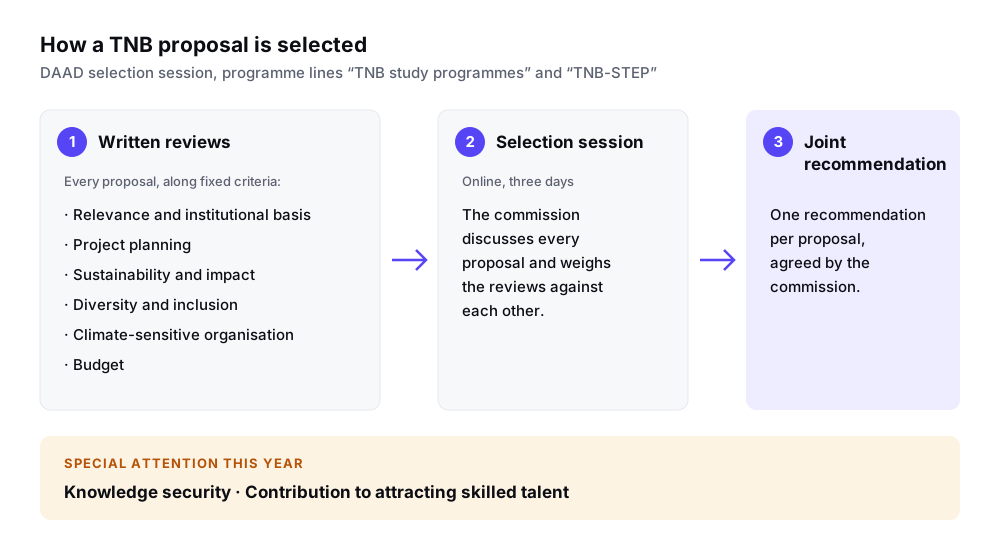
Each proposal is assessed in written reviews along a fixed set of criteria: relevance and institutional basis, project planning, sustainability and impact, diversity and inclusion, climate-sensitive project organisation and budget. In the selection session itself, which ran online this year, the commission discusses every proposal, weighs the reviews against each other and arrives at a joint recommendation. This year, the DAAD asked us to pay particular attention to two aspects: knowledge security and the contribution of programmes to attracting skilled talent.
What makes the difference
Without going into individual proposals, a few patterns stood out to me:
- Strong partnerships are the starting point, not the differentiator. Most proposals rest on credible academic cooperation. What separates them is how concretely they show that the programme will work in practice.
- Demand needs evidence. A general skills gap in a region is not the same as students who will enrol and can afford to.
- Plan for the day after funding. The most convincing proposals show with numbers how the programme will be financed once DAAD funding ends.
- Focus beats breadth. Long lists of measures are less persuasive than a clear priority on what the programme really needs.
- Make inclusion measurable. Good intentions on diversity become credible with targets, responsibilities and ways to check progress.
- Knowledge security is a design question. It works best when it is built into the cooperation from the start, not added as a checklist at the end.
Why I do this
Reviewing is time-intensive, but it is one of the best ways to see how international higher education is being shaped right now, and it sharpens my own view on what makes a proposal convincing. Many thanks to the DAAD team for the excellent organisation and to my fellow commission members for three days of thoughtful discussion.